
Camber Plates And Top Mounts: What They Change
Two different things sit at the top of a coilover strut and people ask about them as if they’re one part. The top mount is what bolts the strut into the chassis. A camber plate is a specific type of top mount that lets the top of the strut move across a slot, and that movement is what actually changes camber. Fit a coilover kit with the standard fixed top mount and you’ve changed ride height and spring rate, but the geometry at the top of the strut hasn’t moved at all.
The bearing inside that mount is its own decision on top of that. A rubber bushed mount and a solid pillowball mount bolt into the same hole and do very different jobs once the car’s moving.
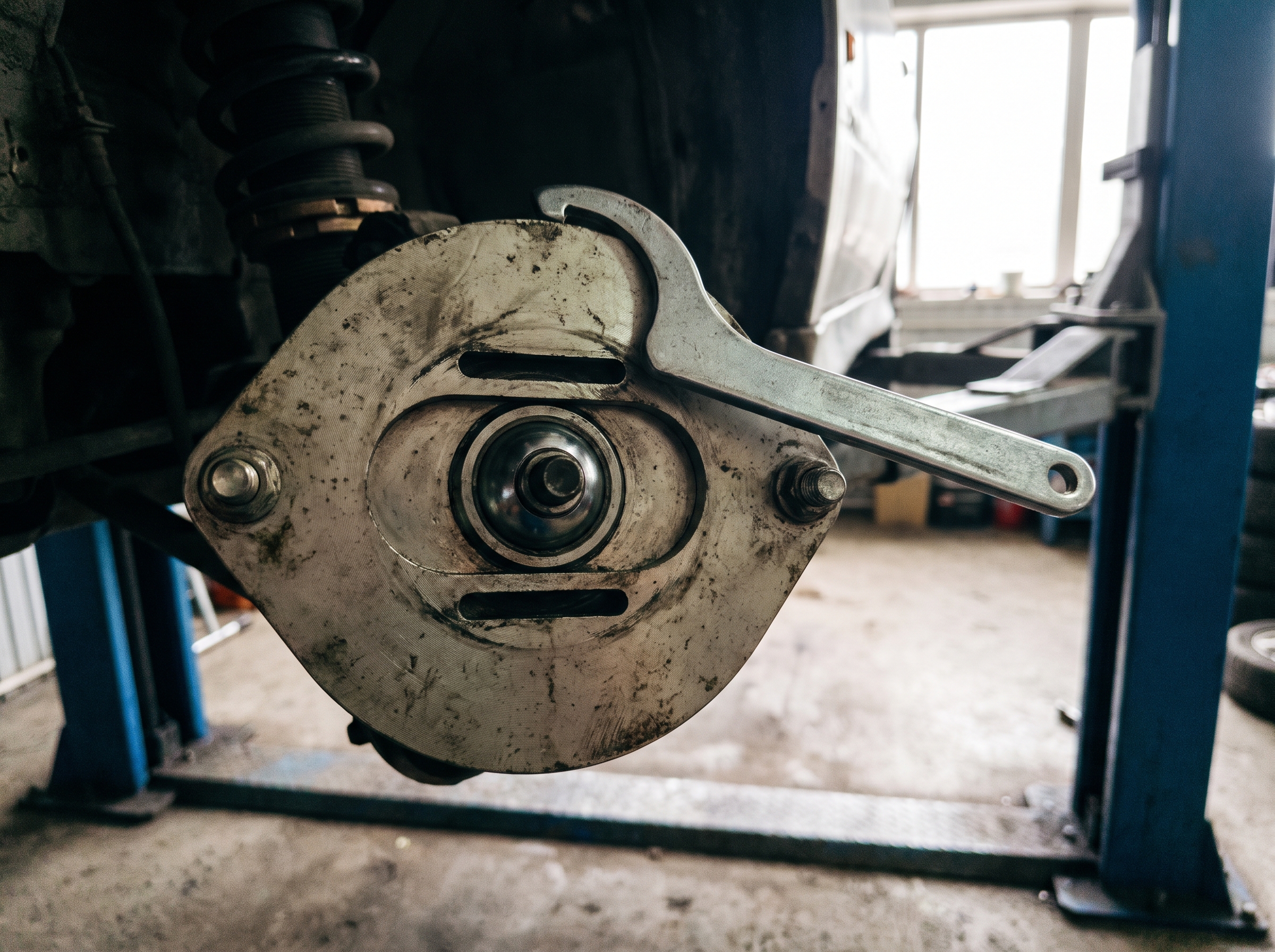
What a camber plate changes that a fixed mount can't
A fixed top mount holds the strut at one angle, set by the hole in the chassis. Every static camber adjustment left on a McPherson strut car happens lower down, on the control arm or the hub, and there’s only so much a lower adjustment can do before it runs out of range or starts pulling caster with it. A camber plate replaces the fixed mount with a plate carrying an oval slot, and the top of the strut can slide within that slot instead of sitting in one fixed hole. Move the top of the strut inward and the wheel gains negative camber, move it back out and you take negative camber out again. It’s adjustment at the one point in the strut assembly a fixed mount doesn’t give you.
Why it matters more once a car's lowered
Drop a car on coilovers and the geometry the suspension was designed around moves with it. As the control arm’s angle changes through the drop, most McPherson setups pick up negative camber at the top of the strut, and how much depends on the car and how far it’s come down. Left at or near standard height, that shift is usually small enough that the built-in lower adjustment covers it. Come down further and the range at the bottom of the strut can run out before camber’s back to a setting that won’t chew through the inside edge of a tyre. A camber plate is what gives that adjustment back, because it works at the end of the strut the lower arm never reaches.
Pillowball or rubber bushed, and what changes on the road
The bearing inside the top mount is a separate choice to whether it’s a camber plate at all. A rubber bushed mount lets the top of the strut flex slightly under load, which is what most road cars run from the factory, and it isolates road noise and vibration from the chassis and the cabin. A solid pillowball mount swaps that rubber for a spherical bearing with no give in it, so the strut’s angle stays exactly where it’s set under cornering load instead of deflecting.
That precision costs something on the road. A pillowball mount passes far more noise and vibration straight into the chassis than a rubber bush does, so expansion joints and rough surfaces come through as a harder, more audible knock at the strut top. On a car that’s mostly track use, that trade is worth it for the geometry staying put under load. On a car still doing daily miles, it’s worth knowing which bearing is in the kit before you order.
Where to go next
For what each BC Racing series is built for and how the kits differ across the range, the series guide covers that. If you’re fitting to a BMW, the BMW coilover guide lists what’s available for that platform, along with what to check on the listing before you order.
Final thoughts
A top mount and a camber plate aren’t the same fitting, and the bearing inside either one is a separate decision again. Know which adjustment you actually need before you order and you won’t end up with a kit that changes the wrong thing.
Cameron, GSM Performance