Call Garreth, Cameron & Jack: 0115 9893488

Free UK shipping on orders over £100.00 & FREE gifts on checkout

Your garage NewAdd your car and see the parts that fit
Useful Links
Your Account

Talk to us

Garreth, Cameron & Jack · Mon to Fri
Call 0115 989 3488Free advice on your build
Thanks, that’s with us. We reply the same working day.
That didn’t send. Please give us a call instead.

Useful Links

Quick Access

Want to chat?

Call Garreth, Cameron, Jack
Today On: 0115 9893488
Click Here For Our Contact Form
Buy gift vouchers today


Free UK delivery over £100
Klarna available at checkout
Established 2003, Nottingham showroom
Call the team: 0115 989 3488

Sparco Arm Restraints: What They Do And Who Needs Them

Driver safety guide

Arm restraints do one job: they keep the driver's arms inside the car. In an open cockpit, or any car that can roll with an open side, an arm that flails outside the roll structure in an accident is exposed to the ground and the barrier, and that is the injury restraints are there to stop.

We sell the Sparco set, certified to SFI 3.3. This guide covers how they work, where they are normally called for, how to set them up and the few drawbacks worth knowing before you buy.

  • Arm restraints keep the arms inside the cockpit in an accident
  • The Sparco set is certified to SFI 3.3, which is not an FIA standard
  • Normally seen in open wheel, open cockpit, off road and drag classes
  • Padded cuffs go round each arm over the suit, with D-ring adjustment
  • The straps mount to the harness lap belt and release with it
  • Black, blue or red padding
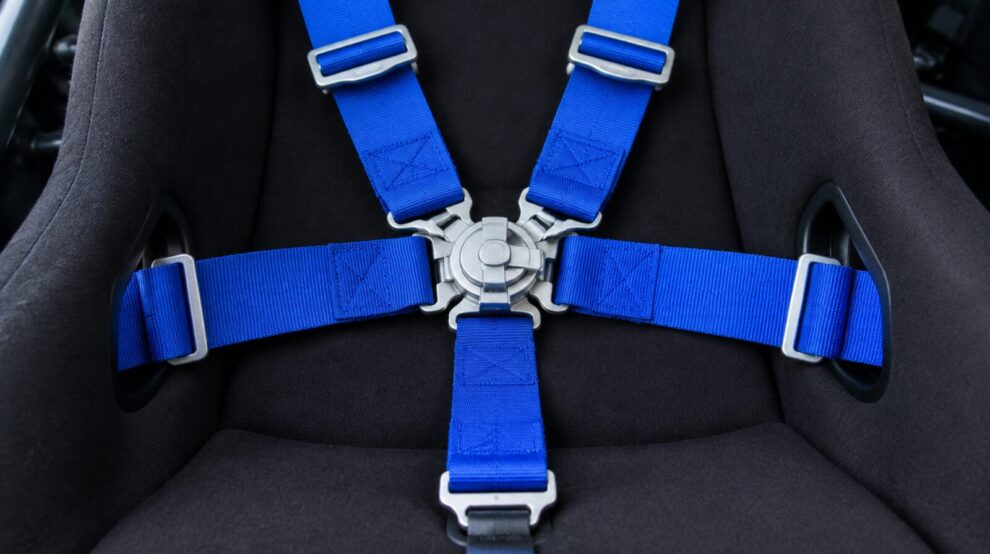
A racing harness with blue straps and a central camlock buckle across a black bucket seat
A harness camlock buckle. Arm restraint tethers are routed to the harness, so they release with it. This photo shows the harness, not the restraints.

Why arm restraints exist

In a heavy impact or a roll, a driver’s arms move on their own. The body is held by the harness and the head by the helmet and head restraint, but the arms are free, and in a car with an open cockpit or an open side they can be thrown outside the car. If the car is rolling at the time, that is where the serious arm and hand injuries come from.

A restraint does not stop you driving. It limits how far each arm can travel, so your hands can reach the wheel, the gear lever and the switches, but the arm cannot leave the cockpit. They sit alongside the rest of the safety kit: helmet, head and neck restraint, harness, suit and, in a closed car with an open window, a window net.

Where they are normally required

Open wheel and open cockpit cars, off road classes and drag racing are where you will usually see arm restraints written into the regulations. They are not a general item for a saloon with a full cage and a window net, and many closed car championships do not mention them at all.

The standard matters too. The Sparco set is certified to SFI 3.3, the SFI Foundation specification for driver arm restraints. SFI is a separate scheme from the FIA, so if your rulebook asks for an FIA standard, an SFI item may not be accepted. Garreth’s advice is simple: read the wording in your own regulations before you buy, not after. Our guide to FIA and SFI approvals explains the difference between the two schemes.

How the Sparco set is worn

Each restraint is a padded cuff that fastens round the arm over your race suit, with a length of webbing and a D-ring adjuster. The cuff is adjusted to the size of your arm, and the webbing is adjusted for how far the arm can travel.

Under the SFI specification the other end of each strap mounts to the harness lap belt, so when you open the harness buckle the restraints come free with it. That matters for getting out of the car quickly. The set is sold as a pair, with the padding in black, blue or red.
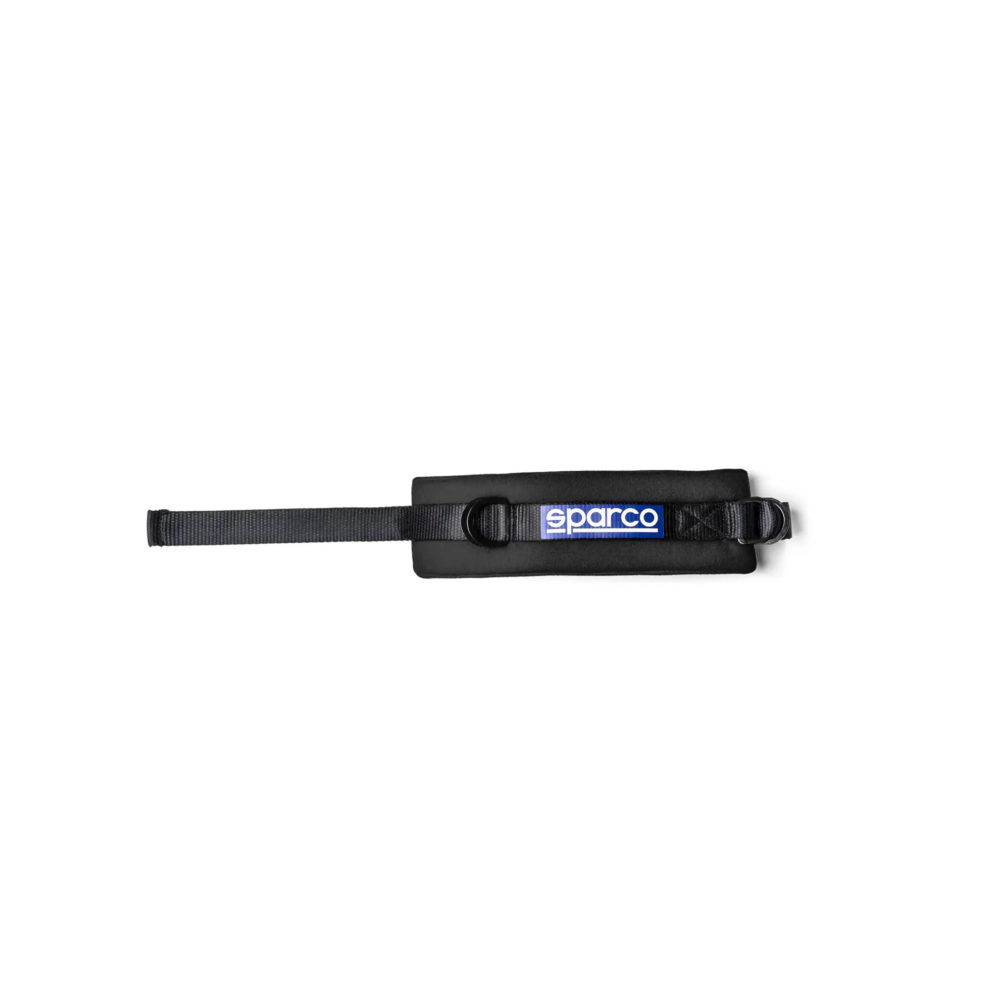
One Sparco arm restraint with black padding, blue Sparco label, webbing strap and D-rings, on a white background
A Sparco arm restraint in black. The padded cuff, webbing and D-ring adjuster are all visible.

Setting them up properly

Adjustment is where restraints either work or get in the way. Too tight and you cannot reach full lock or the switches; too loose and the arm can still get past the edge of the cockpit. Sit in the car with the harness done up and your gloves on, set the tether length, then turn the wheel to full lock both ways and reach for everything you need while driving.

Practise getting in and out with them on, including releasing the harness and pulling your arms free. If you share the car, each driver needs to set the restraints for themselves, because arm length and seating position change the right setting.

The drawbacks

They take some getting used to. The first few sessions can feel restrictive, especially if you tend to move your hands around the wheel, and they add a step to getting strapped in. They also only do their job when they are adjusted for the driver in the car, so they need checking every time the seat position changes.

If your class does not require them and the car is fully enclosed, talk to us before buying. If it does require them, they are not optional, and the SFI label is what the scrutineer will look for.

They limit how far each arm can move so the arms stay inside the cockpit in an accident, while still letting the driver reach the wheel and controls.

No. They are certified to SFI 3.3, which is a separate scheme from the FIA, so check which standard your regulations ask for.

Open wheel, open cockpit, off road and drag racing classes are where they are most often required.

A padded cuff goes round each arm over the suit, and the other end mounts to the harness lap belt so it releases when the harness is opened.

The padding comes in black, blue or red.

💬
Before you orderCheck the rulebook first

The SFI 3.3 Sparco set suits classes that ask for SFI arm restraints, and your regulations decide the rest.

📞
Not sure your class needs them?Tell us what you race

Give us your series and class and we will check what the regulations ask for before you order.

What our customers say

Loading reviews...
Free UK Shipping

On all orders above £100

Showroom

Try before you buy, by appointment

Delivery Tracking

Updates by email and text