Hand Held Fire Extinguishers: Foam, Powder Or Novec, And Why It Matters Where You Use It
Last time I wrote about the OMP plumbed-in systems and said the hand held was a separate decision. This is that decision.
The hand held extinguisher is the item that gets left until the week of the event more often than anything else we sell, usually because people assume the plumbed-in system covers it. In a lot of classes it does not, and you end up buying whatever the trade stand has left.
OMP has added three of them this year. They run from £80 to £298, they are all approved for national and international rally use under FIA and Motorsport UK, and they contain three completely different substances. That last part is the whole point of this page.
What the approvals cover
All four of the OMP hand helds we stock carry FIA and Motorsport UK approval, and the powder one is EN3 certified on top of that. So on paper any of them satisfies a scrutineer looking for a hand held in a rally car.
What the approval does not tell you is what happens when you actually pull the pin. That depends entirely on what is in the bottle, and the three agents behave nothing like each other.
Before you order anything, check your class regulations for the minimum capacity and whether a hand held is required at all. Some classes want one, some want one alongside a plumbed system, and some do not ask for either. We went through that class by class for hillclimbs and sprints in this guide to 2026 Motorsport UK requirements. If you tell us your class when you ring, we will check it with you rather than guess.
Three agents, three different jobs
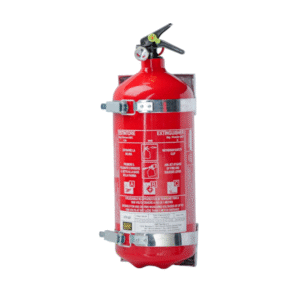
Ecolife foam. OMP’s own foam formulation, in a 2.4 litre bottle. It knocks flames down quickly and it is good at stopping a fuel fire relighting, which is the thing that kills people in cars. OMP describes it as non-toxic and suitable for discharge in an enclosed vehicle interior, and that phrase is the one that matters here. It does leave a mess, but it is a mess you can wash out.
Dry powder. ABC rated, which covers solids, flammable liquids and gases, in a 3 kg bottle. It is non-conductive, so OMP flags it as safe around electric and hybrid systems, and it is pitched at workshops, garages and competition cars alike. It is also by a long way the cheapest of the three.
Novec gas. A clean agent in a 2 kg stainless bottle. It puts the fire out and leaves nothing behind at all, which is why it is the dearest of the three by some margin.
Now the opinion, and I want to be clear that it is an opinion rather than a regulation.
Powder is the most capable extinguisher on this page and it is at its best in the open air. Inside a closed cockpit the foam and the Novec are the easier two to live with, both while you are using them and afterwards.
That is not me saying it is unsafe or not approved. It is approved and OMP is explicit that it is suitable as a secondary hand held in a rally car. It is me saying that if I am strapped in and reaching for something, I want the foam or the Novec, and I want the powder mounted in the service van where it belongs.
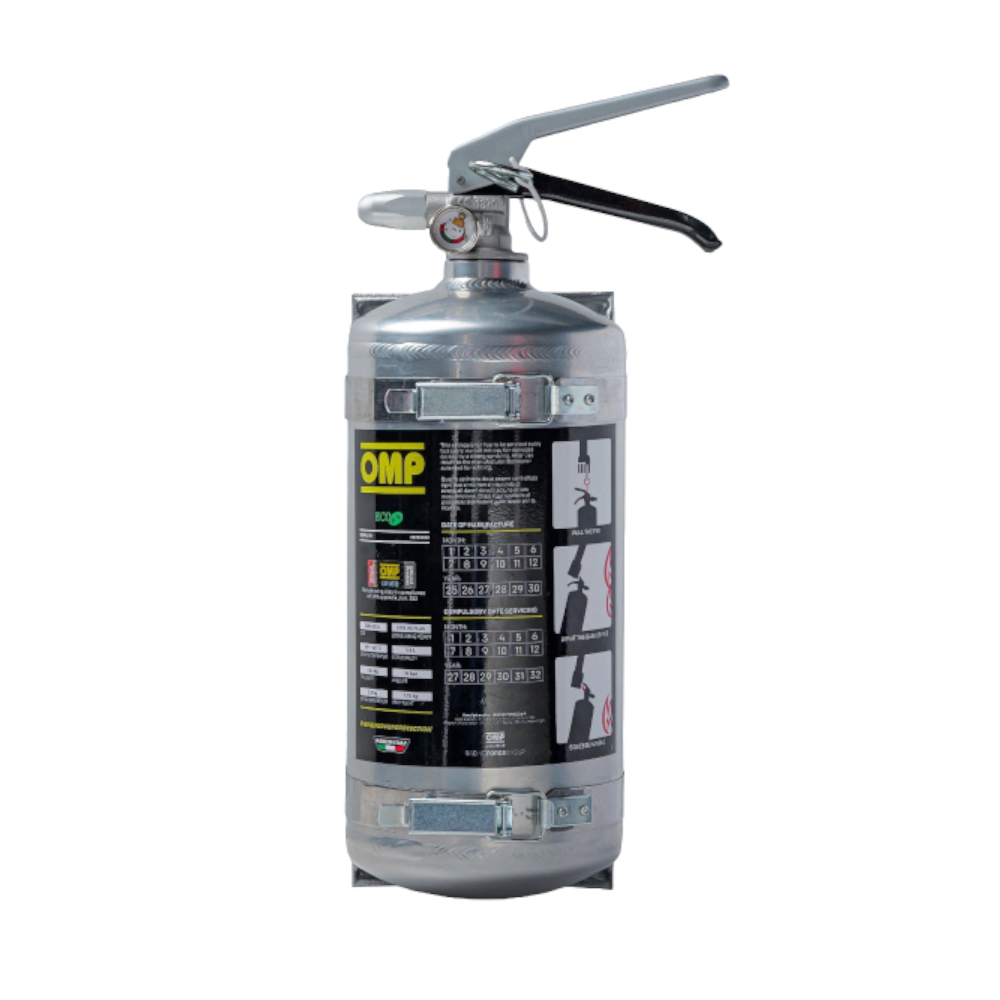
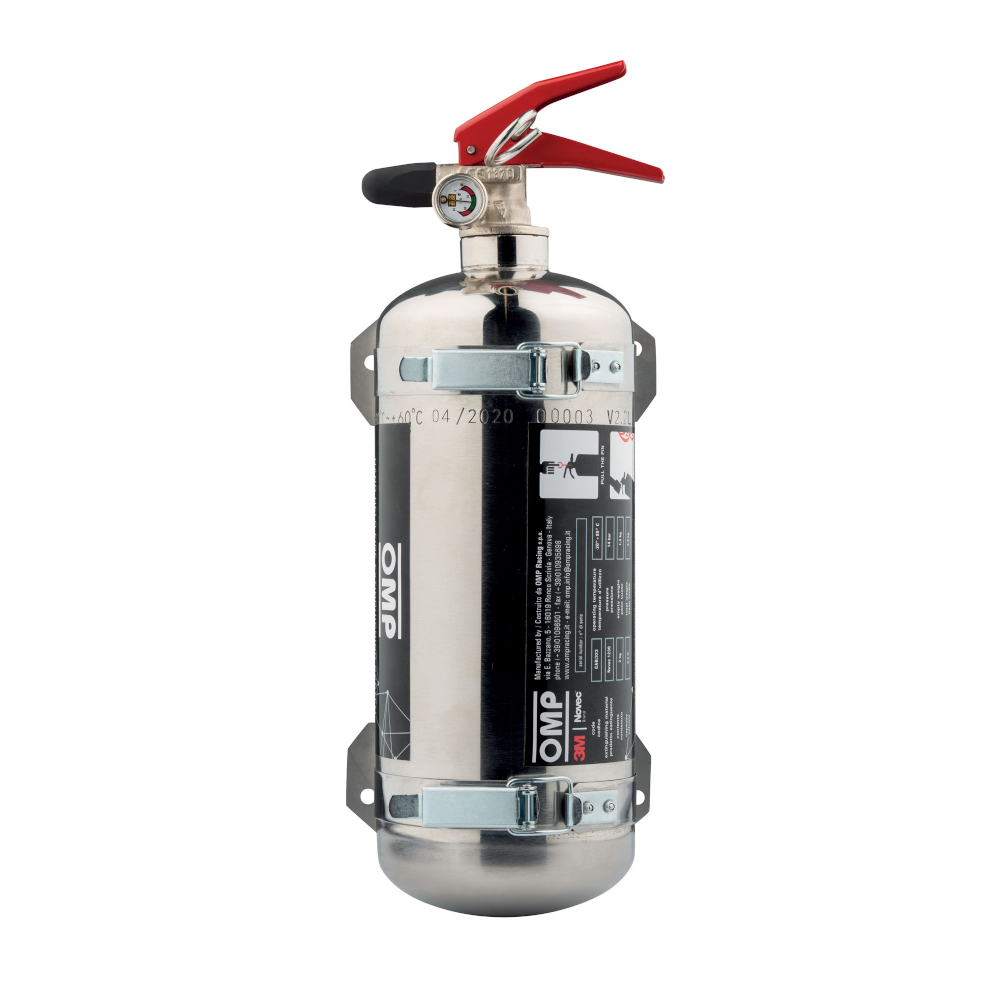
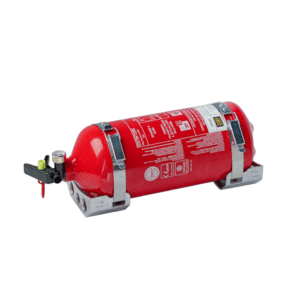
OMP 2.4 Litre Ecolife Plus, steel bottle
The general purpose answer, and the one most rally cars end up with.
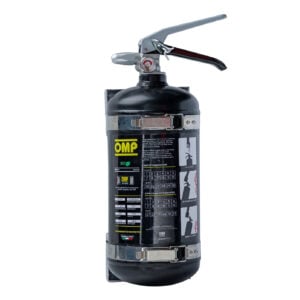
Steel cylinder, 2.4 litres of Ecolife foam, aluminium mounting brackets and stainless steel quick release straps. The straps are worth a mention on their own. A cheap extinguisher bracket is the thing that has your hand fumbling for four seconds while you are trying to get out of a car, and these are the proper cam type that release with one pull.
It is 390 mm long including the handle and firing head, the bottle itself is 300 mm, and the diameter is 132 mm. Total weight is 5 kg. That is the biggest and heaviest of the four, so measure your intended mounting point before ordering.
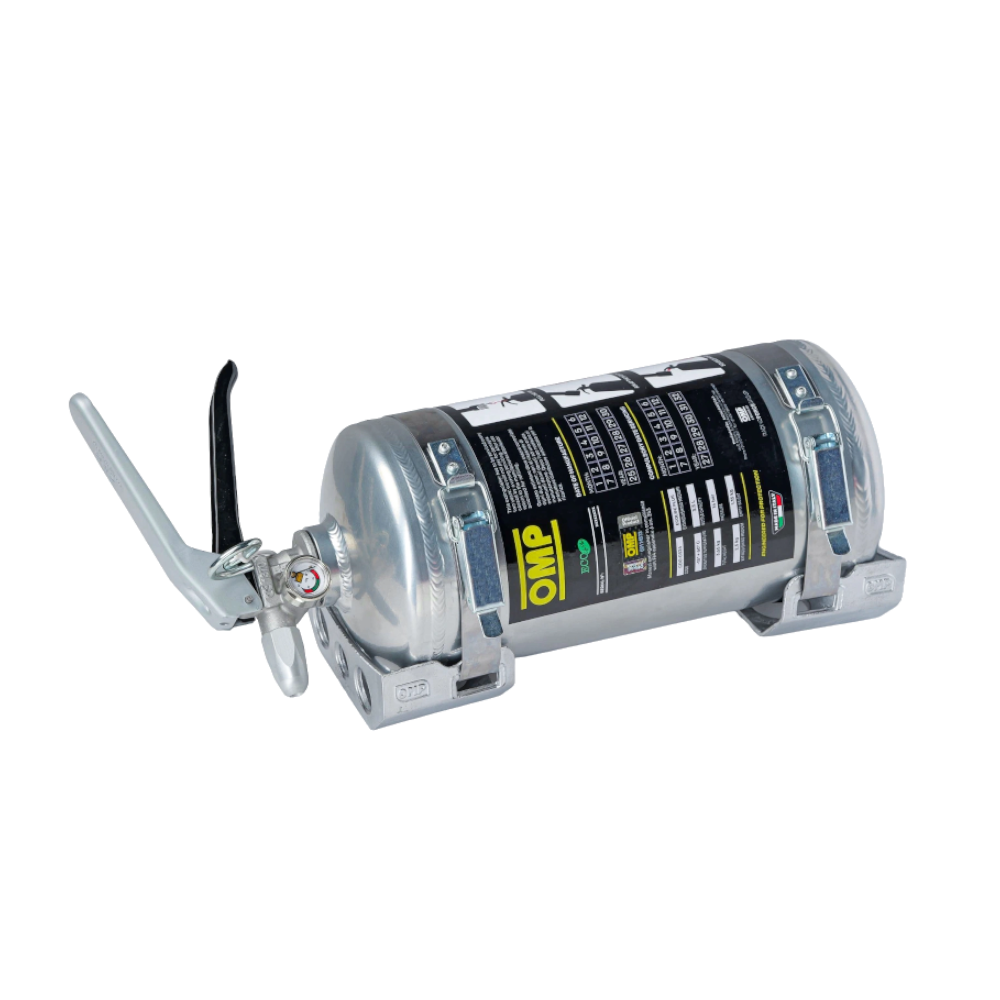
From £188. There is also an aluminium bottle version of the same 2.4 litre Ecolife Plus at 4 kg and 130 mm diameter, which is the one I would take if weight or space is tight. Both are below.
- FIA and Motorsport UK approved for national and international rally
- 2.4 litres OMP Ecolife foam
- Non-toxic, suitable for discharge in an enclosed cockpit
- Aluminium brackets, stainless quick release straps
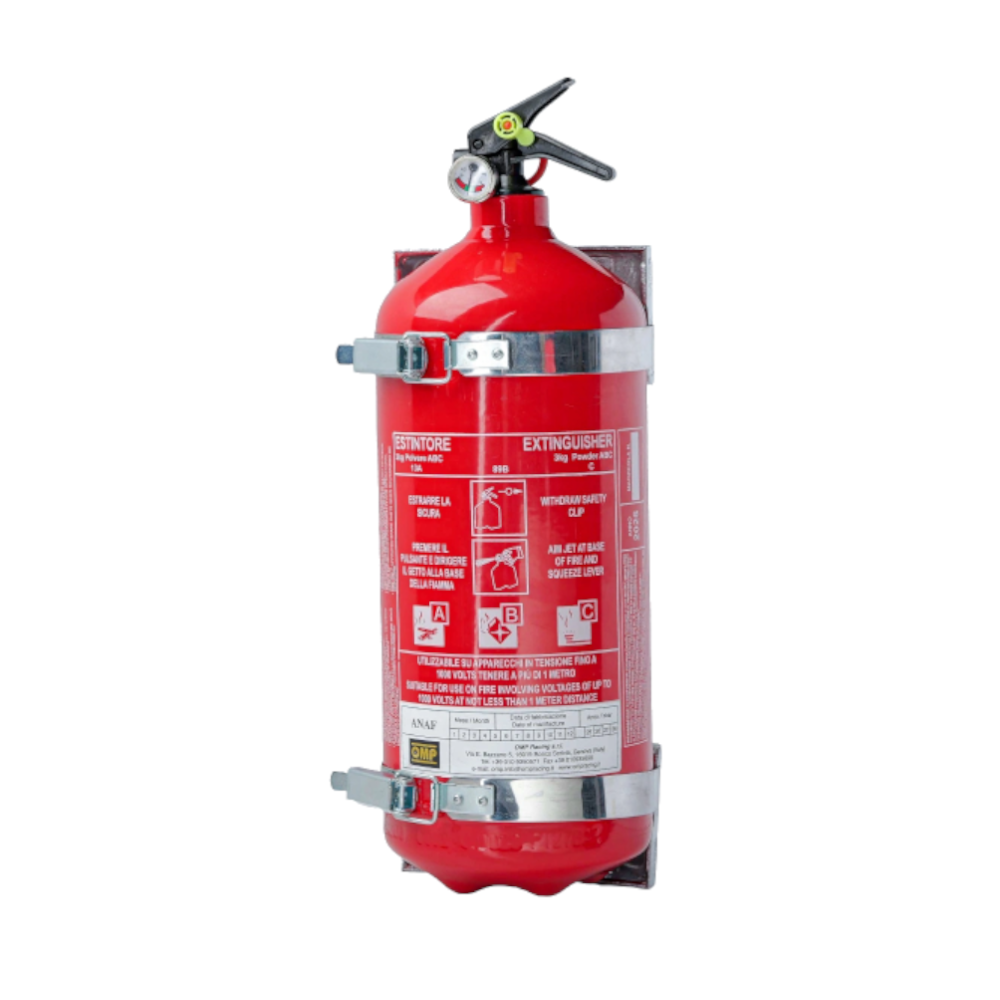
OMP 3kg Dry Powder
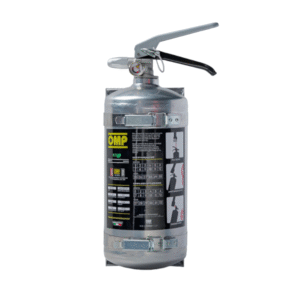
Eighty pounds, and it is the extinguisher I would put in every workshop in the country.
ABC rated so it covers solids, flammable liquids and gases, with a flexible discharge hose that lets you aim it properly rather than waving a nozzle at a fire. Stainless brackets and quick release straps again. It is EN3 certified as well as FIA and Motorsport UK approved.
The non-conductive agent is the bit worth noting if you are working on anything electric or hybrid, which more and more of us are. It is safe around high voltage systems in a way a water based extinguisher is not.
Total length 390 mm, 130 mm diameter, 4.4 kg.
My honest position on this one is above. Buy it for the garage, buy it for the trailer, buy it for the service area. Think twice before it is the only thing within reach of a belted-in driver.
- ABC rated 3 kg dry powder
- EN3 certified, FIA and Motorsport UK approved
- Non-conductive, safe around EV and hybrid systems
- From £80
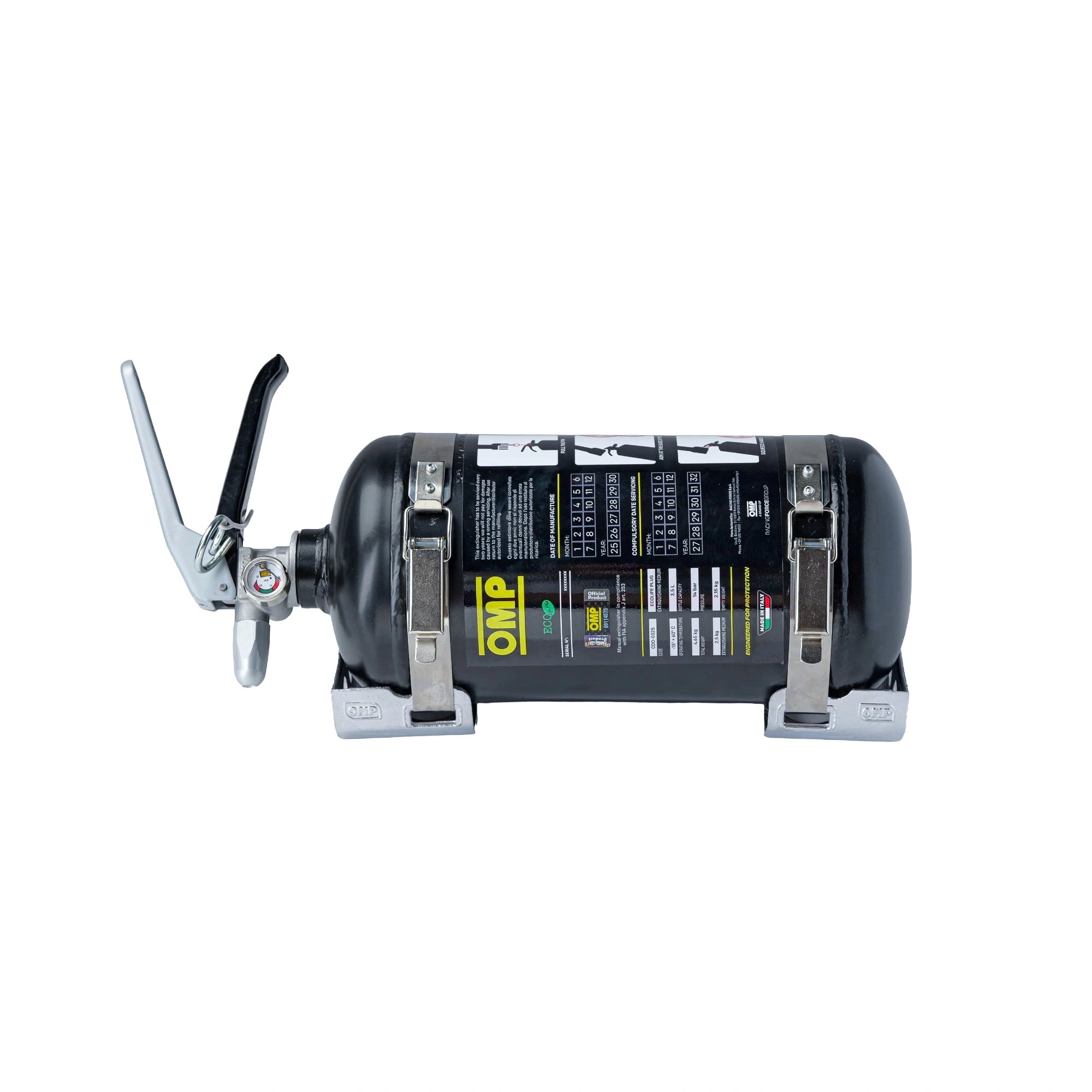
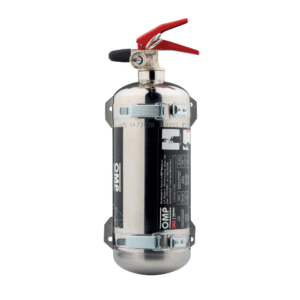
OMP Novec 2kg
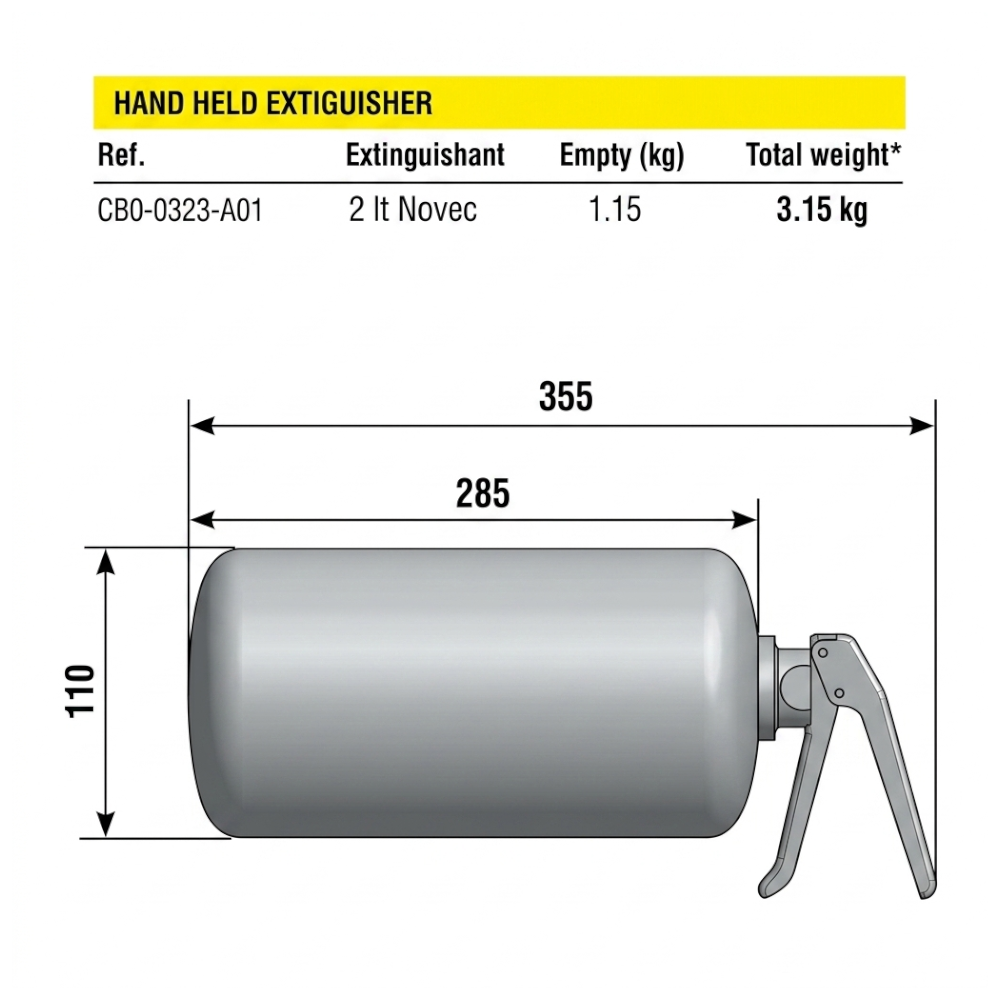
The expensive one at £298, and the one I would have in my own car.
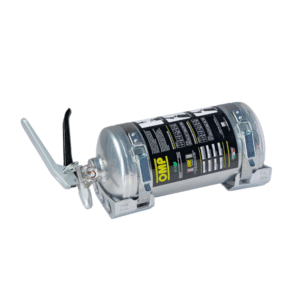
Two kilos of Novec gas in a stainless steel bottle. It leaves no residue whatsoever, so if you have a small fire and you catch it, you have a car you can put back on a stage rather than a car that needs stripping and washing out.
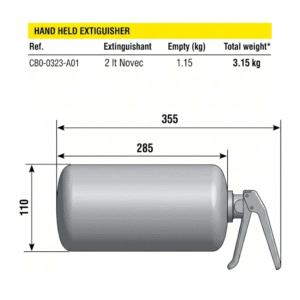
It is also the smallest and lightest of the four by a clear margin: 360 mm long, 110 mm diameter, 3.15 kg total. That 110 mm matters more than the numbers suggest. An extinguisher has to sit somewhere a driver can reach it with a six point harness done up tight, and in a lot of cars that means beside the seat or on the transmission tunnel where there is not much room. Twenty millimetres off the diameter is often the difference between a mounting position that works and one that does not.
Supplied with quick release mounting clamps, and EN3 homologated alongside the FIA and Motorsport UK approvals.
- 2 kg Novec clean agent, no residue
- Stainless steel bottle, 360 x 110 mm, 3.15 kg
- EN3 homologated, FIA and Motorsport UK approved
- Smallest and lightest hand held in the OMP range
The four compared
| Extinguisher | Agent | Capacity | Bottle | Length | Diameter | Weight | Residue |
|---|---|---|---|---|---|---|---|
| Ecolife Plus, steel | Foam | 2.4 L | Steel | 390 mm | 132 mm | 5 kg | Washable |
| Ecolife Plus, alloy | Foam | 2.4 L | Aluminium | 390 mm | 130 mm | 4 kg | Washable |
| 3kg Dry Powder | ABC powder | 3 kg | Steel | 390 mm | 130 mm | 4.4 kg | Heavy, abrasive |
| Novec 2kg | Novec gas | 2 kg | Stainless steel | 360 mm | 110 mm | 3.15 kg | None |
All four are FIA and Motorsport UK approved for national and international rally use. Dimensions are OMP’s published figures and the Ecolife lengths include the handle and firing head.
Where to mount it, which is half the job
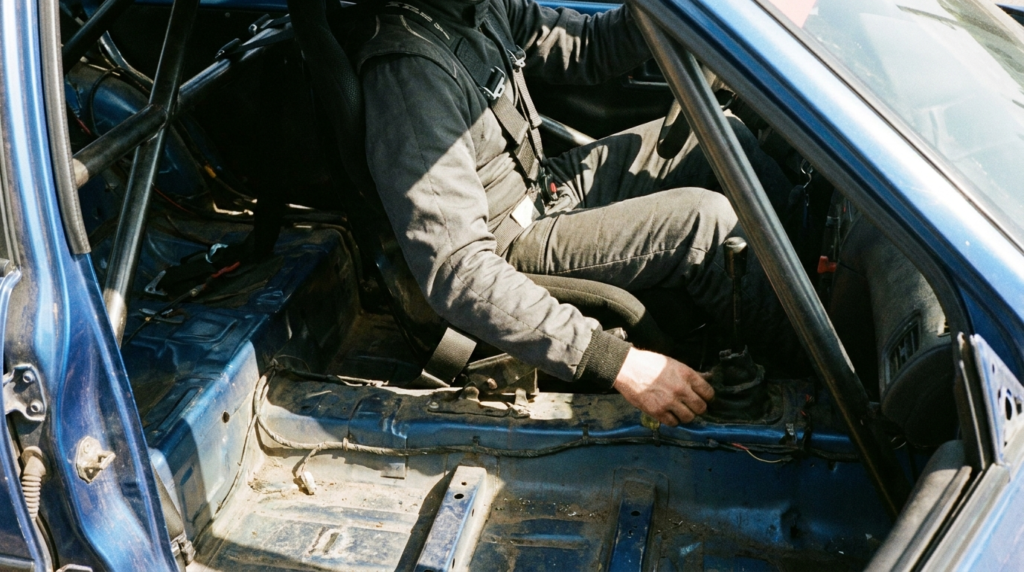
An extinguisher you cannot reach is decoration. Two things I would say having fitted a lot of these.
First, sit in the car with the harness done up as tight as you would actually run it, then reach for where you are planning to put it. Not where you can reach leaning forward. Where you can reach pinned back into the seat. It is a shorter distance than most people expect.
Second, use the brackets and straps that came in the box. All four of these ship with proper metal brackets and quick release straps for a reason. I have seen extinguishers held on with a couple of jubilee clips and a cable tie, and I have seen one come loose in a car. A two kilo steel bottle loose in a cockpit is its own emergency.
Common questions
Do I need a hand held if I already have a plumbed-in system?
Which agent leaves the least mess?
What is the smallest and lightest of the four?
Is dry powder suitable for electric and hybrid systems?
Are all four approved for competition?
Where should it be mounted?
What I would actually buy
One in the car and one in the van, and they should not be the same extinguisher.
In the car: the Novec if the budget stretches, because it is the smallest, lightest and the only one that leaves you a car afterwards. If it does not stretch, the alloy bottle Ecolife Plus. It is a kilo lighter than the steel version, it is safe to discharge with the doors shut, and it is a good extinguisher.
In the van, the trailer and the garage: the 3 kg dry powder, every time. Eighty pounds, covers everything, safe around hybrid and EV systems, and if you have to use it in the open air the mess does not matter.
If you can only buy one, buy the foam. It is the compromise that is least bad in both places.
Final thoughts: check the class, then check you can reach it
Read your regulations for capacity and whether a hand held is required. Then pick the agent based on where you expect to be standing when you use it. Then sit in the car and check you can actually get to it.
The full range is under OMP fire extinguishers, with the other brands we carry in fire extinguishers. If you are also specifying a plumbed-in system, the guide to the OMP systems decodes the FAL, SAL and SST naming.
Send us a message. Tell me the car and the class and we will sort it in one go.
What size or type of fire extinguisher do I need for my car, and do track days require one?
Whether you need one at all depends on your specific class regulations, some ask for a minimum capacity, others do not ask for a hand held extinguisher at all, so check your regs before you buy rather than assume. If you are carrying one regardless, the choice comes down to what matters most to you: OMP’s Ecolife foam (2.4 litre, steel or aluminium) is non-toxic and safe to discharge in an enclosed cockpit, dry ABC powder is the cheapest option at around £80 and covers solids, liquids and gas fires while staying non-conductive around EV or hybrid systems, and Novec gas leaves no residue at all so you can get straight back out and racing, though at around £298 it is the most expensive of the three.
All the OMP extinguishers here carry FIA and Motorsport UK approval for rally use. A common setup for anyone running two is a Novec or foam extinguisher within the driver’s reach in the car, and a dry powder unit kept in the service van or garage.