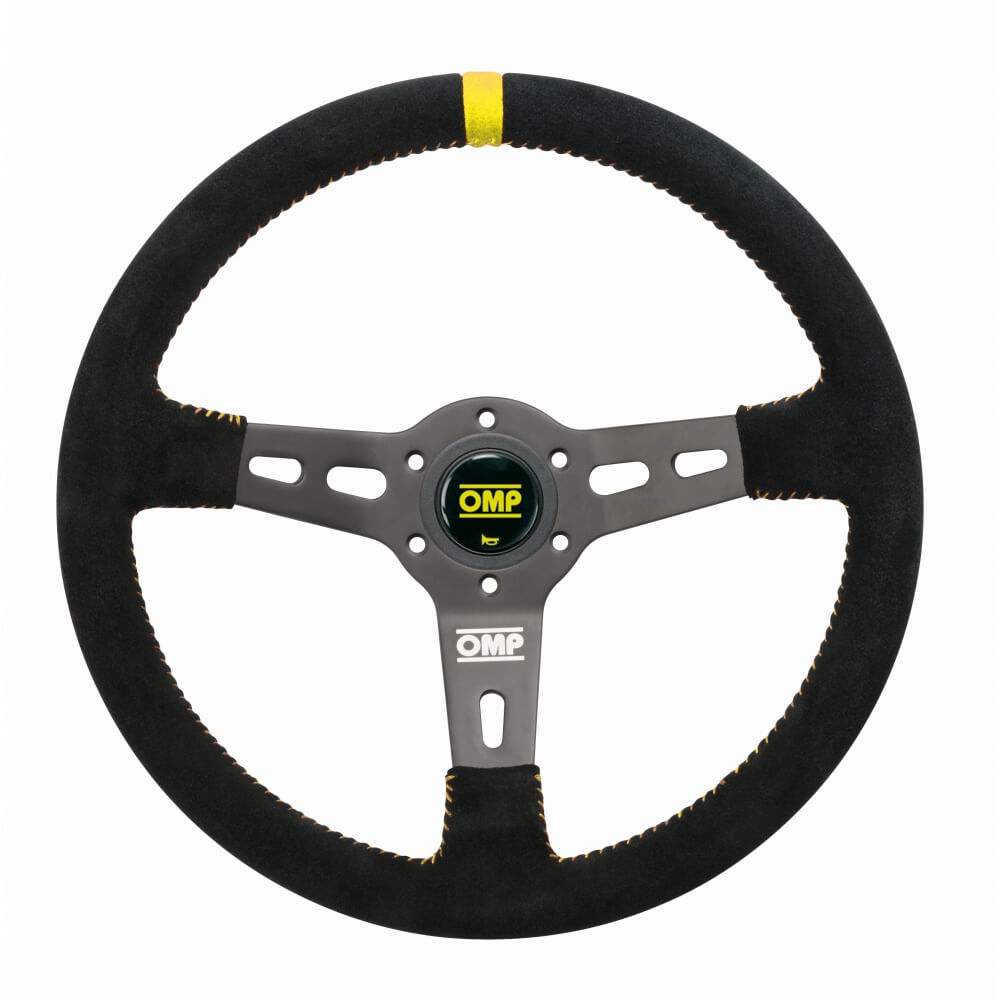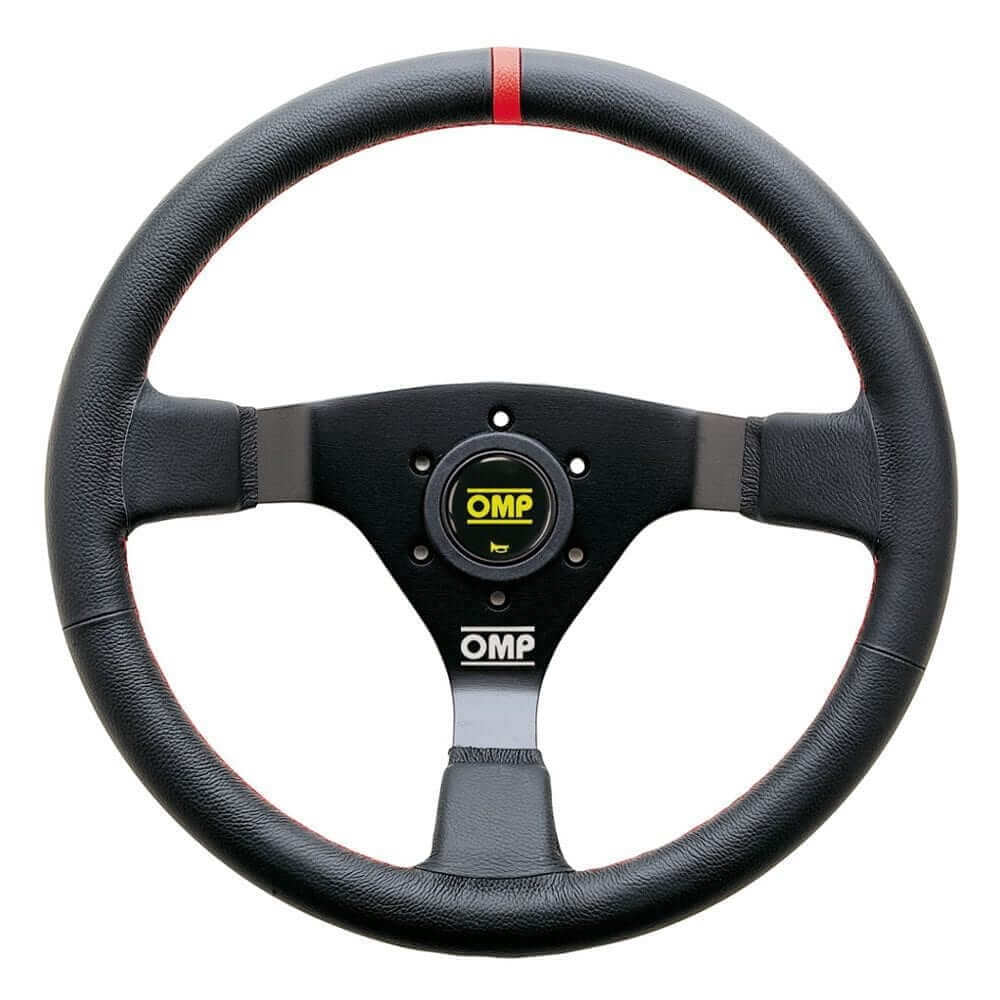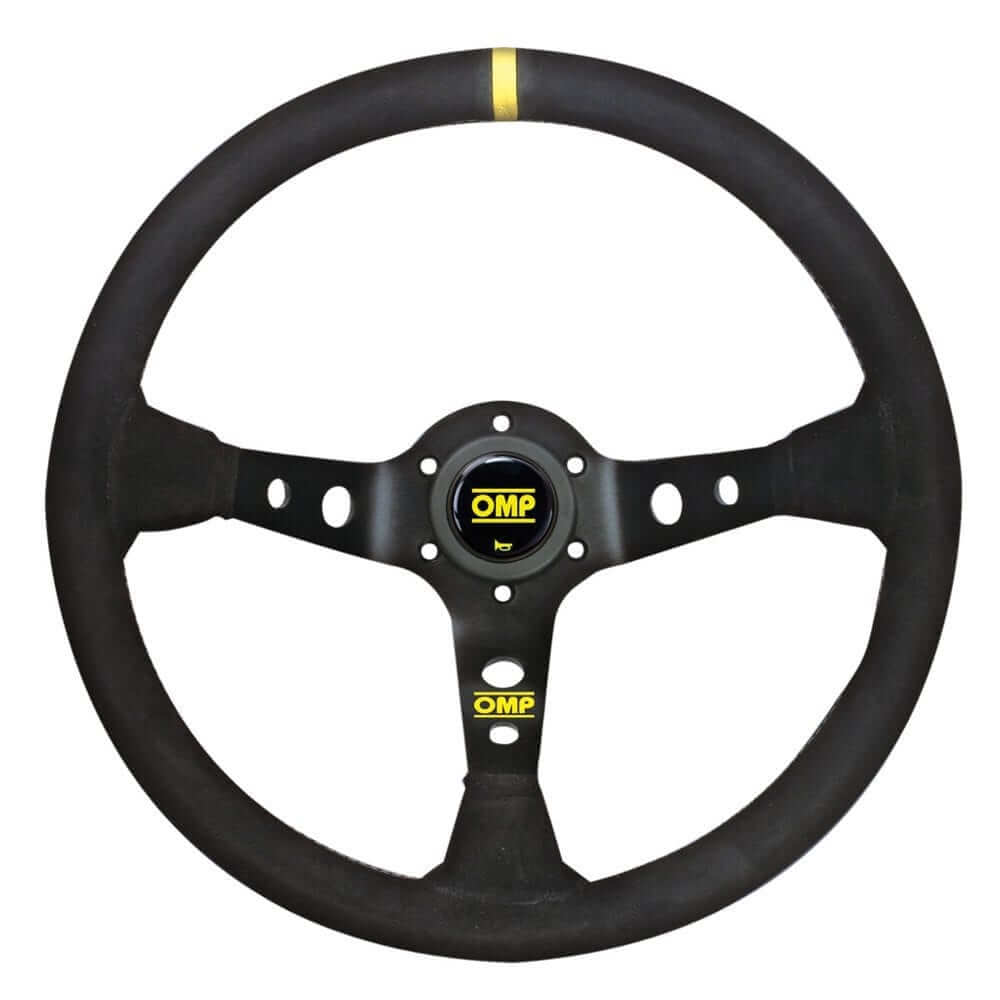
Flat, Semi Or Deep? The Definitive Guide To Steering Wheel Dish
Dish is the one steering wheel measurement people ring us about after they have already bought the wheel. It is the distance the rim sits away from the column once everything is bolted up, and it decides whether the wheel lands where your hands want it or somewhere you have to reach for.
Every wheel we sell carries two figures on its listing: the dish type in words, and the dish size in millimetres. This page explains what those mean, draws all four types to the same scale so you can see the difference, goes through what each brand actually offers, and covers the part that catches most people out, which is what happens when you add a boss kit and a quick release behind the wheel.
- Dish runs from 0mm flat to 95mm deep across the wheels we stock
- A quick release adds about 60mm on its own, a deep dish’s worth
- You can add a spacer later, you cannot take dish away
- Deep dish keeps your thumbs clear when the wheel spins back
- The millimetre figure is on every listing, and it is the number to buy on

What dish actually is
Take a steering wheel off a car and look at it edge on. The centre boss, the flat plate that bolts to the hub, sits on one plane. The rim you actually hold sits on another. Dish is the distance between those two planes, and it comes from the angle of the spokes: flat spokes put the rim level with the boss, spokes angled out towards you push it away from the column and towards your chest.
That is the whole of it. A deep dish wheel is not a bigger wheel, and it does not change the steering ratio or the leverage; a 350mm wheel is a 350mm wheel whether it is flat or 95mm deep. What changes is where your hands sit in the car, and on a car with a fixed seat and a fixed column that is the only adjustment you have.

The four dishes, drawn to scale
Here are the four, side by side, all drawn to the same scale on a 350mm wheel. The dashed line is the mounting face on the boss, and the driver is off to the right.
How far the rim sits from the column, drawn to scale
Both directions are drawn to the same scale, so the gaps you can see are the real proportions. The millimetre ranges are the actual figures published on the wheels we stock.
| Dish | On our listings | What it does | In stock |
|---|---|---|---|
| Flat | 0mm | Rim level with the boss, sits furthest from you | 46 across all four brands |
| Shallow | 30 to 43mm | A modest step towards you | 39, almost all MOMO |
| Semi | 63 to 72mm | A clear step closer, still easy to live with | 14 |
| Deep | 85 to 95mm | Rim well forward, close to the chest | 13 |
Counts are the wheels showing in stock on this store as this page went up. Six more carry no published dish figure at all.
Who each dish suits
Flat, and when it is the right answer
Flat is what you fit when something else has already used up the room. A quick release, a long boss kit or a spacer all push the wheel towards you before the dish is counted, and a flat wheel puts it back where it belongs. It is also the recoverable choice: if it turns out too far away, a spacer fixes it.
Shallow, the quiet middle
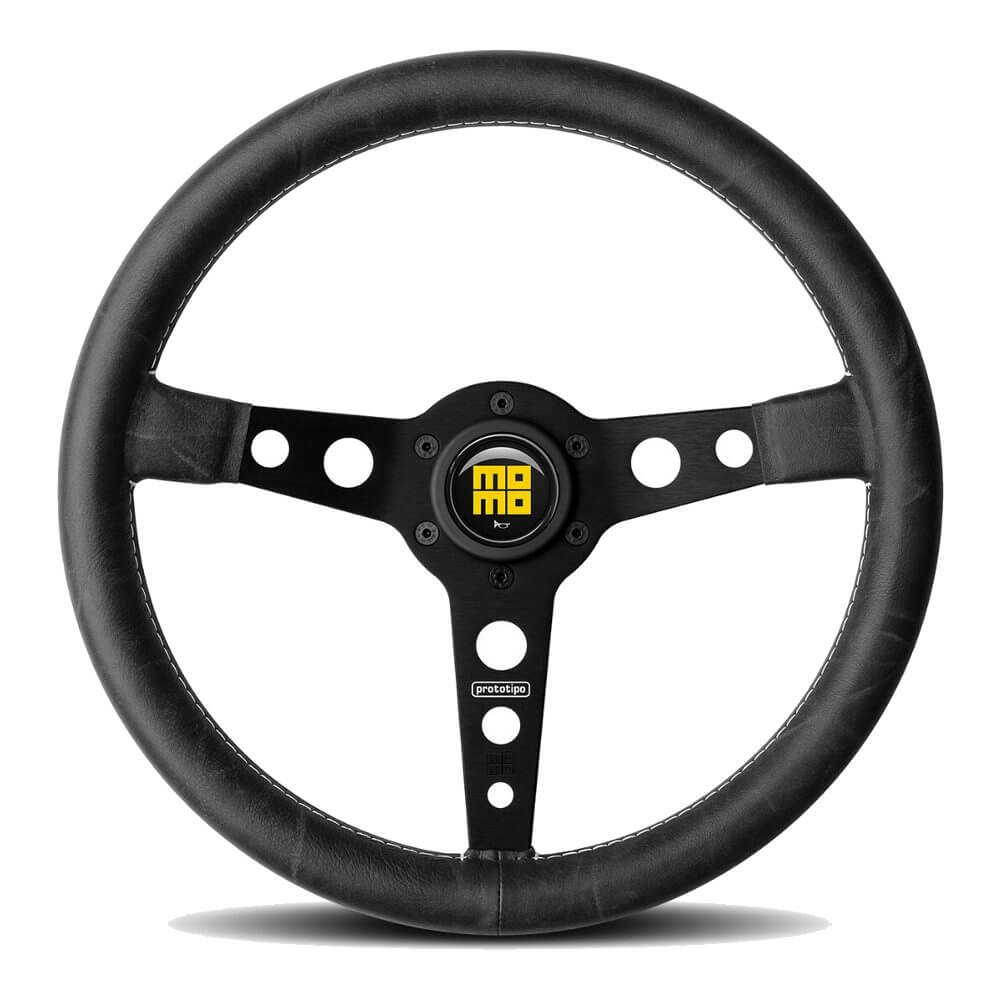
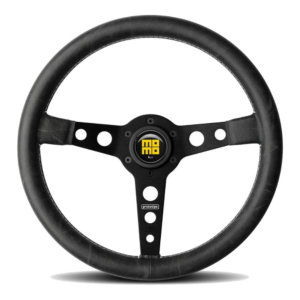
A small correction for a wheel that felt a fraction too far away on a plain boss. Most of the classic MOMO shapes live here, the Prototipo and the Grand Prix among them, so plenty of people end up shallow because they bought the shape they liked.
Semi, the one that suits a plain boss
Boss kits are cut to put the wheel roughly where the factory one sat, so a semi dish on a boss with nothing else behind it lands in a genuinely good place for most people. It is the setting a lot of rally cars run and the one we reach for most on a straightforward fit.
Deep, and the real reasons for it
Two that matter. Your seat is fixed a long way back and the rim needs to come to you. And, if you drift, the dish keeps your thumbs and fingers clear of the spokes when you let the wheel spin back through your hands. Deep dish also tends to help knee clearance, not hurt it.
The honest way to think about it: dish is how you move the wheel to your hands when the seat and the column will not move any further. Everything else follows from that.
Buy on the millimetre, not the word
This is the bit worth slowing down for, because it is where people get caught. Flat, shallow, semi and deep are useful shorthand, and we use them ourselves, but no manufacturer defines them against a millimetre range and the brands do not agree with each other.
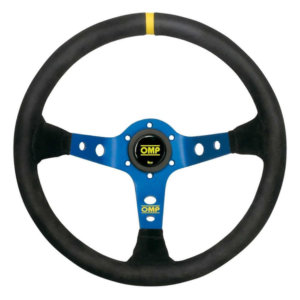
Here is the proof, in the makers’ own words. MOMO describe the Mod. 07 as having a deep 72mm dish. OMP describe their RS, at exactly the same 72mm, as mid-depth dished. Same distance to the millimetre, two different tiers, both from the people who built the wheels. Sparco call a 39mm wheel flat; MOMO call a 42mm wheel half dished. And OMP do not use the word dished at all until 70mm, so everything shallower is simply flat to them.
The word “shallow” is worth a special mention: none of the four manufacturers use it. It is a retailer’s word, ours included, for the band between flat and semi. That is fine as shorthand as long as you know that is what it is.
What each brand offers
All four brands we stock cover more than one dish, but they do it in different ways. Here is the range as it stands, with the millimetre figures off the listings.
Sabelt: the clearest example of the three
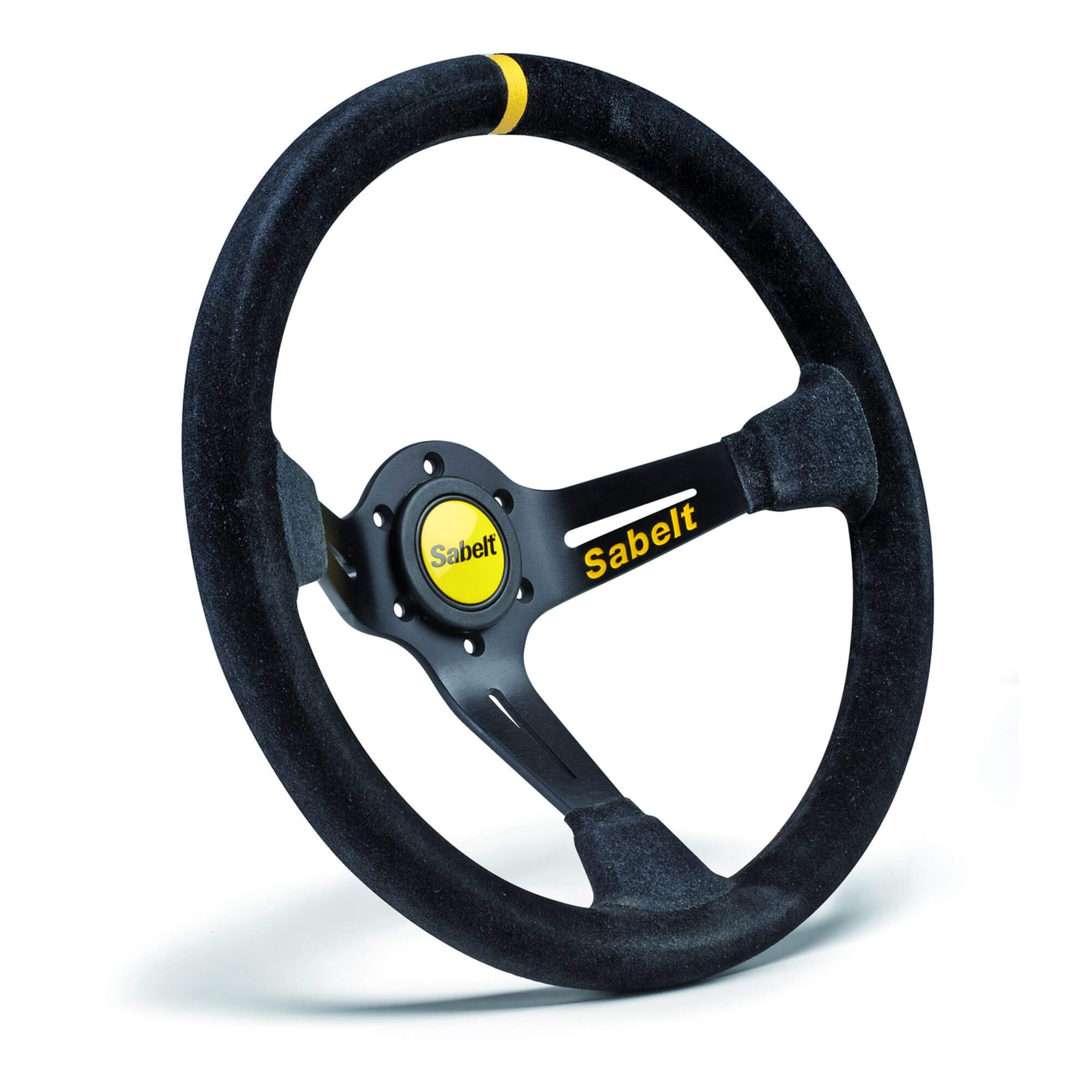
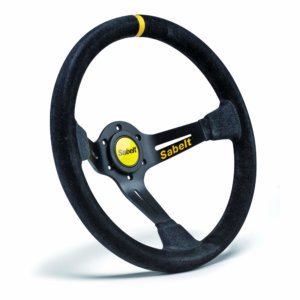
Sabelt is the range to look at first if you want to understand dish, because the wheels look closely related and the dish is the main thing separating them. The SW-633 is flat, the SW-465 is a 65mm semi and the SW-390 is a 90mm deep. Same design language, three positions, and picking between them is genuinely a decision about where you want your hands.
Sparco: the widest spread
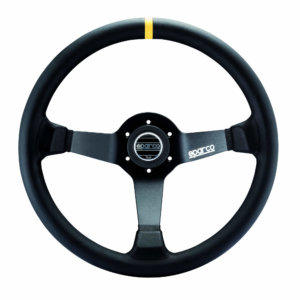
Sparco cover all four steps. Flat runs from the P222 upwards, the 323 and 383 sit at 39mm, the 345 and L777 are semi at 63 to 65mm, and the 325 is the deep one at 95mm. If you want to try dish without committing, Sparco is where the ladder is easiest to climb.
-
From £159.50 Incl. VATFrom £159.50 Excl. VAT Select options This product has multiple variants. The options may be chosen on the product page
-
From £152.00 Incl. VATFrom £152.00 Excl. VAT Select options This product has multiple variants. The options may be chosen on the product page
OMP: flat heavy, with a proper deep end
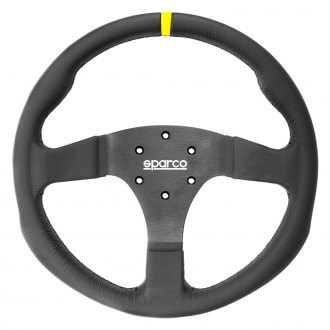
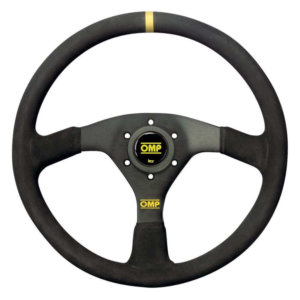
OMP is where to look for a flat wheel: 23 of them in stock, from the Mugello up. Then it jumps, because OMP publish a depth figure only for the wheels they consider dished and there are just three values in the whole range. The RS is 72mm, the WRC is 70mm, and the Corsica and Rally family are all 95mm, which is why you see so many Corsicas in rally cars. There is nothing from OMP in the shallow band at all.
-
From £172.00 Incl. VATFrom £172.00 Excl. VAT Select options This product has multiple variants. The options may be chosen on the product page
-
From £159.50 Incl. VATFrom £159.50 Excl. VAT Select options This product has multiple variants. The options may be chosen on the product page
-
From £160.00 Incl. VATFrom £160.00 Excl. VAT Select options This product has multiple variants. The options may be chosen on the product page
MOMO: the deepest bench in the middle
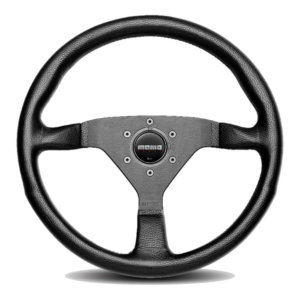
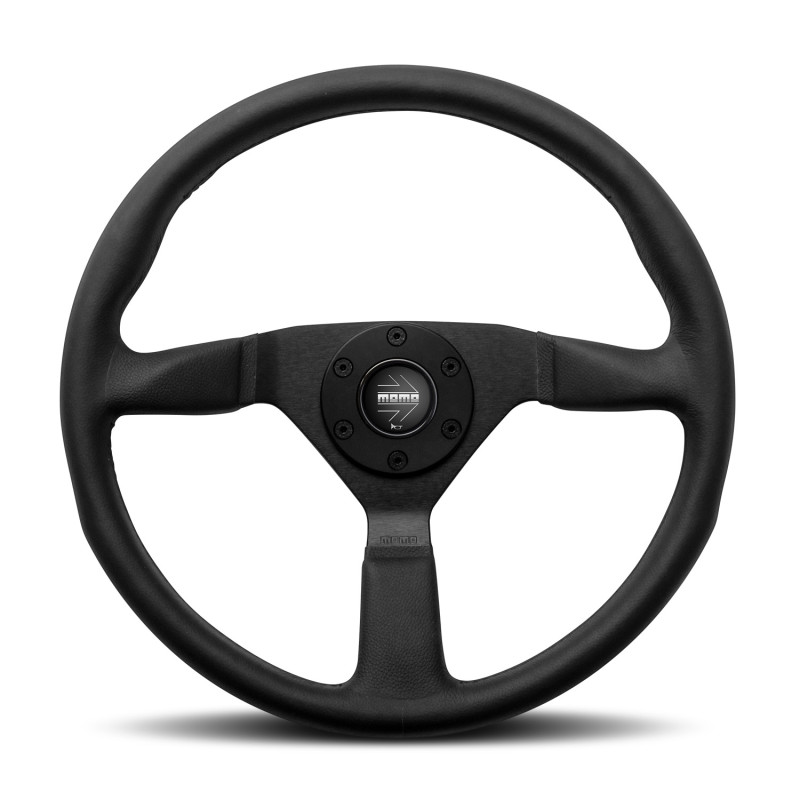
MOMO have the most wheels and the most choice in the shallow band, which is where the Prototipo, Indy and Grand Prix shapes live at 37 to 39mm. The Montecarlo and Model 31 are flat, the Model 03 and Mod.07 are at 70mm, and the Gotham and Drifting are the 90mm deep ones. The Drifting is named after the job it does, which saves us explaining it.
-
From £244.99 Incl. VATFrom £244.99 Excl. VAT Select options This product has multiple variants. The options may be chosen on the product page
-
From £237.99 Incl. VATFrom £237.99 Excl. VAT Select options This product has multiple variants. The options may be chosen on the product page
-
From £205.00 Incl. VATFrom £205.00 Excl. VAT Select options This product has multiple variants. The options may be chosen on the product page
-
From £227.99 Incl. VATFrom £227.99 Excl. VAT Select options This product has multiple variants. The options may be chosen on the product page
The stack: boss, spacer and quick release
Dish is only one part of where the wheel ends up. Everything between the column and the wheel adds to it, and it all adds up in a straight line towards your chest.
Start with the boss kit, because it is the part you do not get to choose. It is the car specific adaptor from your column splines to the wheel bolt pattern, and its job is to put the wheel roughly where the factory one sat. Its length is set by your car: Works Bell publish the overall length of every boss they make and the range runs from 56mm to 144mm depending on the vehicle, so there is nearly 90mm of difference between cars before anyone adds anything.
That is why the diagram below measures from where the standard wheel sat instead. Once the boss has done its job, everything after it is what you are adding.
How much closer than standard the wheel ends up
Measured from the standard wheel position, drawn to scale. Dish figures are off our own listings; the 60mm quick release figure is the depth B-G Racing publish for their quick release system, and it matches what Driftworks quote for theirs.
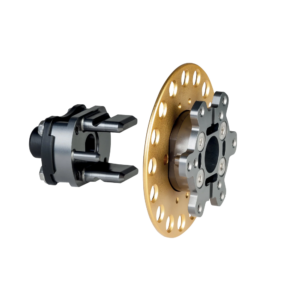
A quick release goes between the boss and the wheel and adds about 60mm. That is not a rounding error, it is a deep dish wheel’s worth of depth on its own, and it is the number people forget. Fit one to a car that already has a 90mm deep dish and the rim ends up 150mm closer to you than the wheel the car came with.
Spacers work the same way and are the useful counterpart: the Sparco one adds 50mm, OMP do 20 to 100mm, B-G do 10 to 120mm, and B-G make an adjustable one covering 40 to 70mm in a single part. Those are what you fit when the wheel ended up too far away.
-
From £28.00 Incl. VATFrom £28.00 Excl. VAT Select options This product has multiple variants. The options may be chosen on the product page
-
From £73.00 Incl. VATFrom £73.00 Excl. VAT Select options This product has multiple variants. The options may be chosen on the product page
-
From £211.00 Incl. VATFrom £211.00 Excl. VAT Select options This product has multiple variants. The options may be chosen on the product page
The quick release rule
If you are running a quick release, buy a flat dish, or a semi at the very most. That is the rule we give on the phone and we have never regretted it.
The arithmetic does the arguing. A quick release is around 60mm, which already puts you where a semi dish would have. Add a 90mm deep dish on top and you are 150mm closer than standard, your elbows have nowhere to go, and on plenty of cars the indicator stalks end up out of finger reach behind the rim. People do this, and then sell the wheel on a forum a month later.
The other way round works beautifully. A quick release with a flat wheel lands about where a semi dish would have on its own, which is a good place to be, and you get to take the wheel off to climb in past a cage or a bucket seat. That is the combination we sell most of, and it is the honest answer to a tight cabin.

Working out what you need
- Set the seat to your legs firstGet the pedals right before you think about the wheel at all. In a car with fixed rails and a bucket seat, that position is settled for you, and everything else has to work around it.
- Do the wrist testShoulders flat against the seat, arms stretched out, drape your wrists over the top of the rim. If the rim lands at your wrists you are about right. If you are reaching for it with your shoulders coming off the seat, you need the wheel closer.
- Work out the gap in millimetresRoughly how much closer does the rim need to come? That number is your budget, and the steps between bands are about 30mm each.
- Subtract anything going behind the wheelA quick release takes about 60mm of that budget before the dish is counted, and a spacer takes whatever it is marked. Spend what is left on the dish.

If you would rather not work it out on paper, ring us with the car, the seat and whether there is a quick release in the plan, and Cameron will tell you which dish to be looking at. That conversation takes two minutes and it saves a return.
What we would fit
On a plain boss kit with nothing else behind it, a shallow or a semi is the one we reach for most. The boss is cut to put the wheel roughly where the factory one sat, so a modest dish lands in a genuinely comfortable place for most people, and the OMP WRC and the Sabelt SW-465 have both been doing that job for years.
The moment a quick release enters the conversation, go flat. That is not a preference, it is the 60mm doing the talking.
For drifting, buy the deep one. The thumb clearance when the wheel spins back through your hands is a real benefit that nothing else gives you, and it is the one discipline where 90mm earns its place rather than just looking the part.
Garreth’s rule on the money: the dish costs you nothing extra, so choose it properly at the point of order. A flat and a deep version of the same wheel are usually within a few pounds of each other, so the expensive mistake is not the wheel, it is buying twice. And if you are genuinely torn between two, take the flatter one. A £28 spacer will move it towards you later, and nothing on earth will take dish back out of a wheel.
Ring us on 0115 9893488 with the car, the seat and whether a quick release is in the plan, and Cameron will tell you the millimetre figure to aim for before you spend anything.
Common questions
Does a deeper dish make the steering heavier?
No. Leverage comes from the diameter, not the dish. A 350mm wheel gives you the same leverage whether it is flat or 95mm deep; what changes is where your hands sit. If you want lighter steering effort, look at diameter instead.
What dish do I need with a quick release?
Flat, or semi at the outside. The quick release adds its own length between the boss and the wheel, so a deep dish on top of it usually puts the rim too close. This is the single most common mistake we unpick.
Where do I find the dish of a wheel on your site?
On every steering wheel listing, in the specification table. Wheel Dish Size is the figure in millimetres and Wheel Dish Type is the word. Buy on the millimetre.
Can I use a spacer instead of buying a deeper wheel?
Yes, and plenty of people do. A spacer moves the whole wheel towards you, so a flat wheel plus a 50mm spacer puts the rim in a similar place to a semi dish. It is also the reason we tell people to buy the flatter of two wheels: adding a spacer later is easy and cheap, and taking dish out of a wheel is impossible.
Does a deep dish make my knees hit the wheel?
Usually the opposite. A flat wheel sits further forward and lower in your lap, which is where knee and thigh contact tends to come from. Moving the rim back towards you generally buys clearance. If your knees are catching now, more dish is as likely to help as hurt.
Am I better off with a flat wheel because I am tall?
Probably not. Tall drivers usually end up with the seat a long way back for their legs, which leaves the wheel further away, so they tend to want more dish, not less. The thing that decides it is your legs against your arms, not your height, which is why the wrist test above is worth two minutes of your time.
Will a deep dish clear my indicator stalks?
Usually yes, because the dish moves the rim away from the stalks. The problem runs the other way: a deep dish plus a boss and a quick release can put the rim so far forward that reaching the stalks past it becomes awkward. Tell us the car and we will talk it through.
Is dish the same as the drop on a flat bottom wheel?
No. Dish is measured front to back, away from the column. A flat bottom is the shape of the rim itself, seen face on. A wheel can be flat bottomed and any dish you like.