The definitive guide to flat-bottom racing steering wheels
A flat-bottom wheel can solve a very specific problem: the lower rim is in the way when you climb into the car. Choosing one still takes a few measurements. A 330mm D-shaped wheel and a 270mm formula wheel put your hands, the dashboard and the mounting face in very different places.
Garreth’s starting point is the car and how it is driven. Cameron’s is the space around the driver. We have brought both into this guide, with the flat-bottom and cut-rim choices currently listed on our website, their dimensions and the fitting details worth checking.
Range checked 6 November 2026 · Dimensions in millimetres · Online availability and display stock confirmed separately
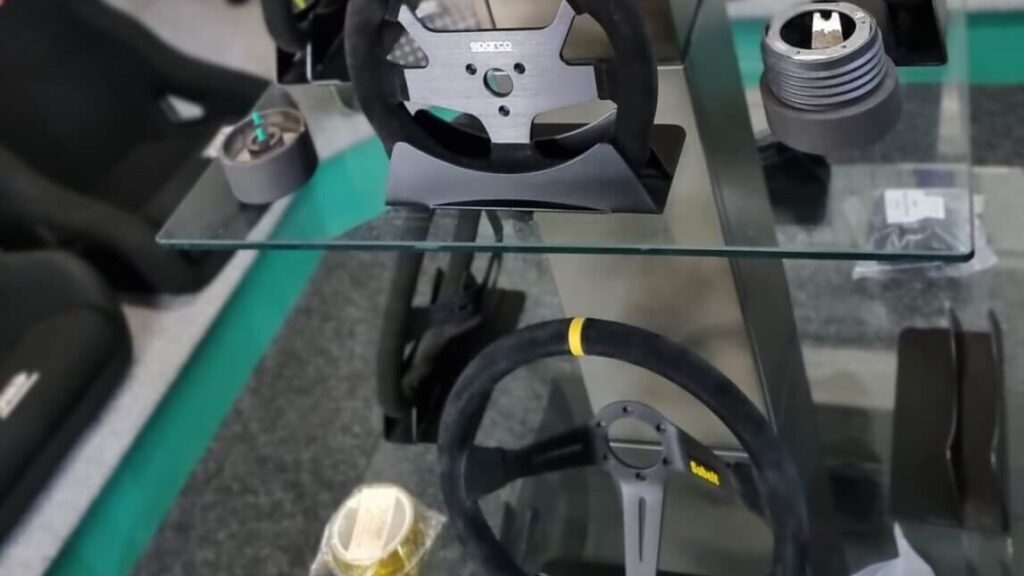
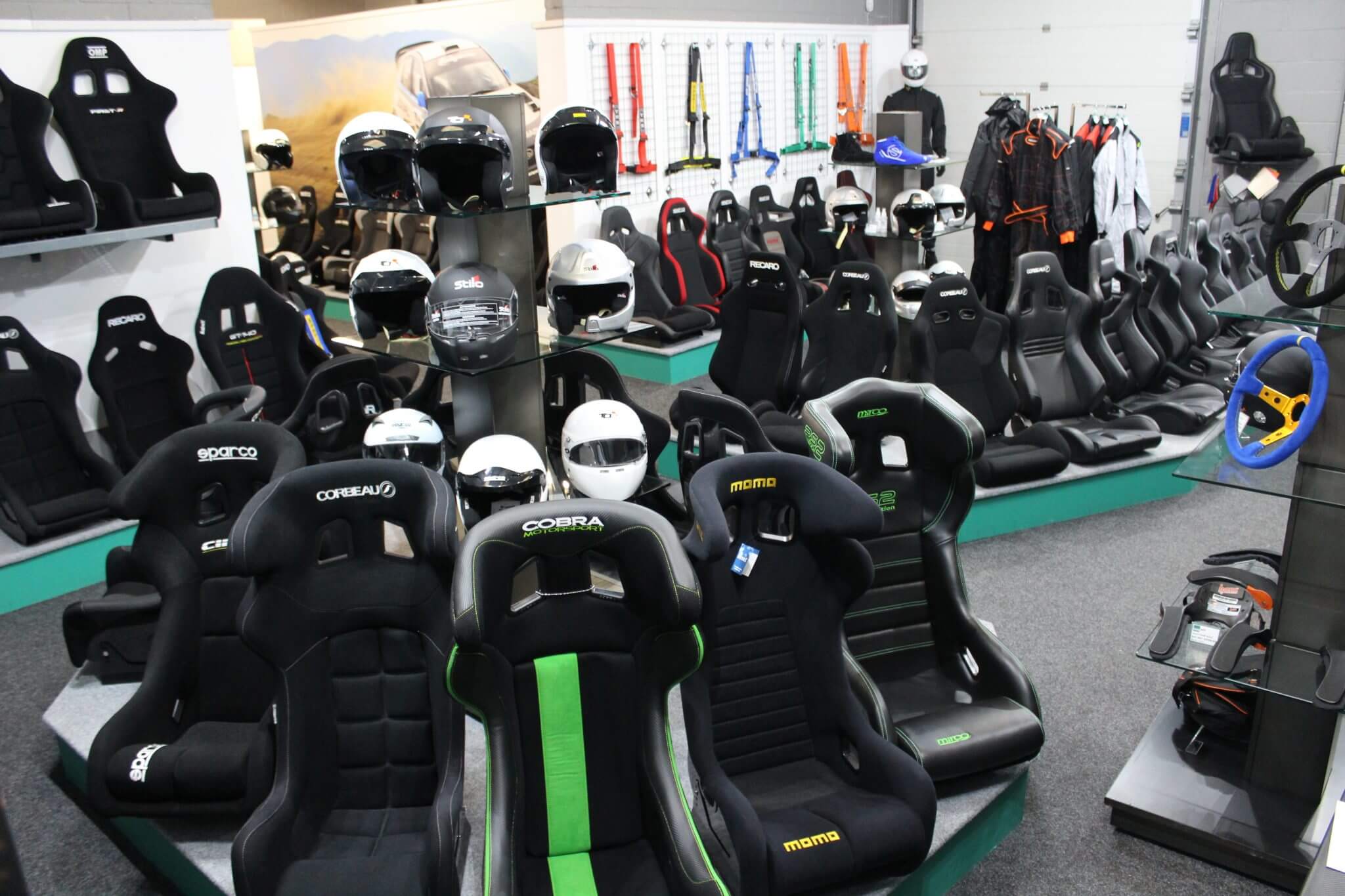
Steering wheels, a boss kit and a quick release on our showroom display. Ask which models are available to view before travelling.
30 listingsWith a flat or shortened lower rim
4 makersMOMO, OMP, Sparco and Sabelt
250–350mmPhysical-car wheel widths
3 sim modelsClearly separated below
Read the shape and the dish separately
A flattened lower rim changes the outline seen from the driver’s seat. Dish is the front-to-back offset between the mounting plane and the grip. A wheel can have either feature independently. Our steering-wheel dish guide explains the reach measurement in more detail.
Width and overall height
Width is the maker’s nominal diameter or widest span. Overall height is the full top-to-bottom envelope. A Model 27 and Model 27C can both be 270mm wide, with heights of 235mm and 195mm respectively.
That height difference describes the full outline. It does not mean a 40mm gain under your knees, because the upper cut also contributes.
Dish and grip section
Dish changes the reach towards your hands. The boss, spacers and a quick release contribute their own depth. Add them together when comparing a replacement with the wheel already fitted.
Grip section is the thickness and shape of the rim itself. A 35 × 25mm oval grip feels different from a 35mm round section, particularly with gloves.
Cameron’s fitting view
Measure with the seat and column in their driving positions. We want the distance to the lower rim and the available reach, plus a clear view of the instruments. A cardboard outline of the proposed wheel is useful before buying, provided its centre is placed at the actual steering axis.
Published dimensions on one scale
These bars use the same millimetre scale for every model. The darker bar is width; the lighter bar is overall height. They make the differences between closed and open versions easier to see.
Manufacturer dimensions, not fitting templates. “Not stated” in the tables means the maker does not publish that dimension in the reference used here. Paired sizes follow the same order across the row.
13 live listings · diameter and finish options included
Closed-rim flat-bottom wheels
This group keeps a continuous perimeter around the wheel. It includes clear competition D-shapes and road-style wheels with gentler flattened lower sections. Compare the images as well as the nominal diameter, because the amount of flattening varies considerably.
MOMO gives the widest spread of materials and finishes here. OMP’s Superquadro and Kubic have measured rectangular envelopes; the Cromo uses a more restrained lower cut. Sparco’s R353 adds a shallow dish. Sabelt’s SW-732 and SW-733 share one size-selectable listing.
Smooth / perforated leather Confirm hub and fixings
Garreth’s top tip
Choose the rim shape around the movements you make. A closed D-shaped wheel is a good place to start when you want a familiar upper arc and some extra entry space. If the car needs a lot of lock, think through where the lower flat passes your hands as the wheel turns.
The Model 88 offers two sizes within a conventional competition D-rim. Both retain a closed top and a 43mm dish. The 320mm version reduces the width across your hands; the 350mm version gives more leverage for the same steering torque. Check that 43mm reach against your existing wheel, including the boss and any spacer.
The Model 30 has a more pronounced lower cut than the Model 88. MOMO draws the 320mm wheel at 280mm overall height. Our listing offers standard and two-button versions. Those controls are useful when the car already has a plan for their wiring. The 39mm dish stays part of the reach calculation on either version.
The R353 keeps a mostly conventional upper rim with a restrained flat lower section. Its 330mm width sits between the two Model 88 sizes. Sparco’s technical drawing gives a 36mm dish. It is a useful starting point when you want lower-rim clearance without moving to a compact formula shape, provided the reach suits your driving position.
OMP’s Superquadro combines a 330mm width with a 290mm height. The broad lower flat is easy to see in the product image, and the suede rim has an oval 35 × 27mm handgrip. Its flat dish keeps the reach close to the mounting plane. Compare the 290mm height with your available space, then check the upper rim against the instruments.
The Kubic is shorter and narrower than the Superquadro, with flattened upper and lower edges. OMP gives 310 × 265mm overall dimensions and a 35 × 28mm grip. It suits a driver reducing the whole rim envelope while retaining a closed perimeter. Think through how that shape passes your hands when the car needs steering lock.
This listing contains two Sabelt models: SW-732 at 320mm and SW-733 at 330mm. Both use the brand’s flat GT-style lower rim and suede covering. The SW-732 manufacturer code is RFVO2038. Select the diameter deliberately, because the model name follows that choice. Ask us to confirm the complete envelope if the cockpit has very little spare room.
The Trek puts a pronounced flat-bottom outline into a 350mm wheel. MOMO specifies microfibre covering and a 38mm dish, with silver cross spokes and a contrasting black lower spoke. It offers a larger diameter than the compact competition D-rims. Check the Trek-specific mounting screws with the boss kit; the spoke arrangement is part of the installation.
The Trek R shares the Trek family’s 350mm flat-bottom form and 38mm dish. Its silver spoke treatment and leather grip with AirLeather inserts give it a different finish from the microfibre Trek. Pick by the surface you want in your hands and the interior finish. Match the Trek fixing arrangement before ordering either version.
The Eagle has one of the clearest flat lower sections in MOMO’s street range. Smooth leather and AirLeather inserts surround anthracite spokes, with a central horn button. Its 350mm diameter and 40mm dish make it a larger, shallow-dished option. It is worth considering for a trimmed interior where you want a D-shaped rim and a conventional centre pad.
The Quark has a subtly flattened lower outline and a more heavily contoured grip than the plain competition rims. MOMO specifies polyurethane with AirLeather inserts, plus a version with red leather inserts. At 350mm and 40mm dish, it belongs with the larger street-style choices. Its lower cut is modest, so request a physical measurement if clearance drives the purchase.
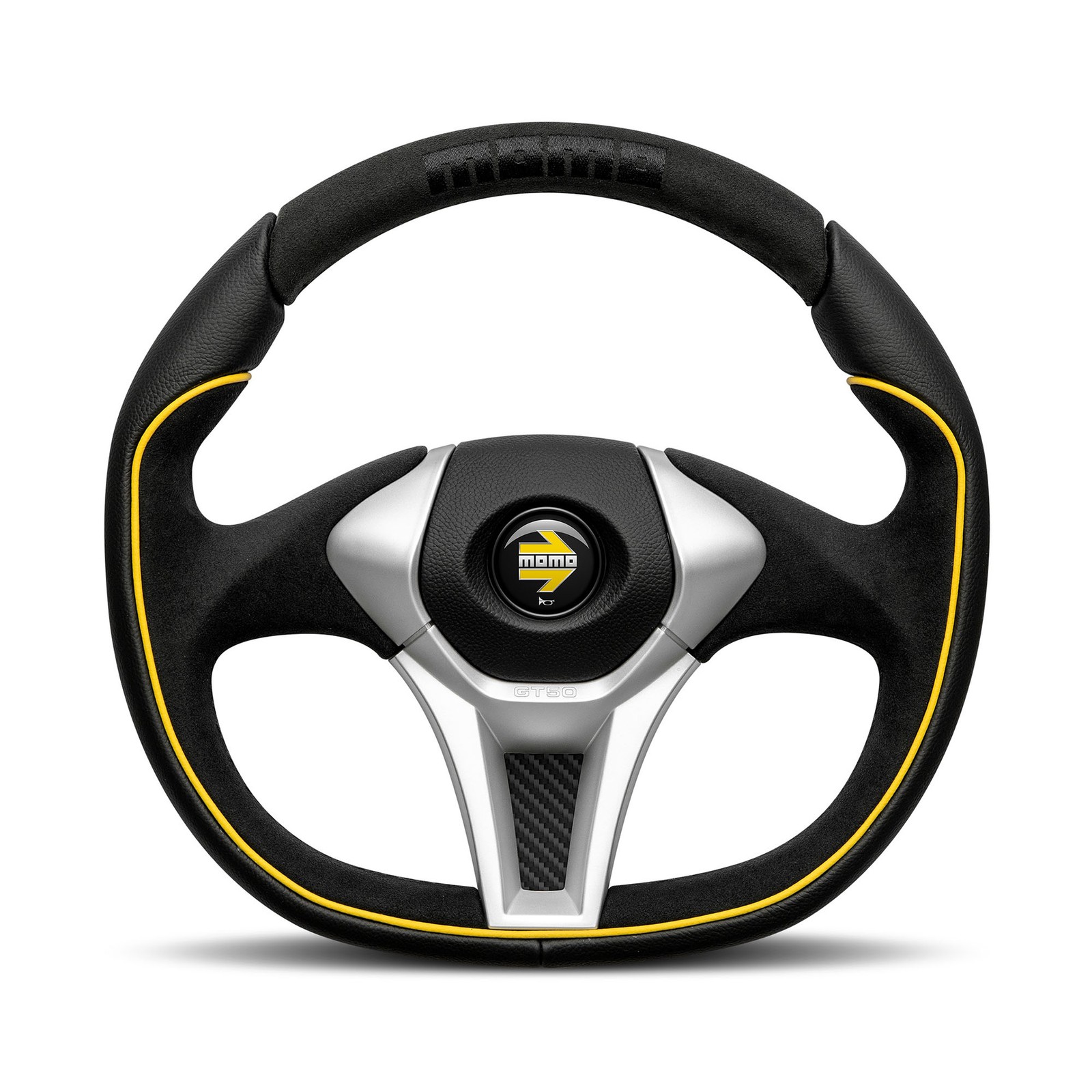
The GT50 2.0 has a shallow flat lower rim, a central pad and a matte carbon-fibre detail at six o’clock. Black leather and microfibre combine with yellow detailing. MOMO lists 350mm diameter, 37mm dish and a 34 × 29mm grip. It gives a different finish and hand feel from a suede competition wheel while retaining a shortened lower outline.
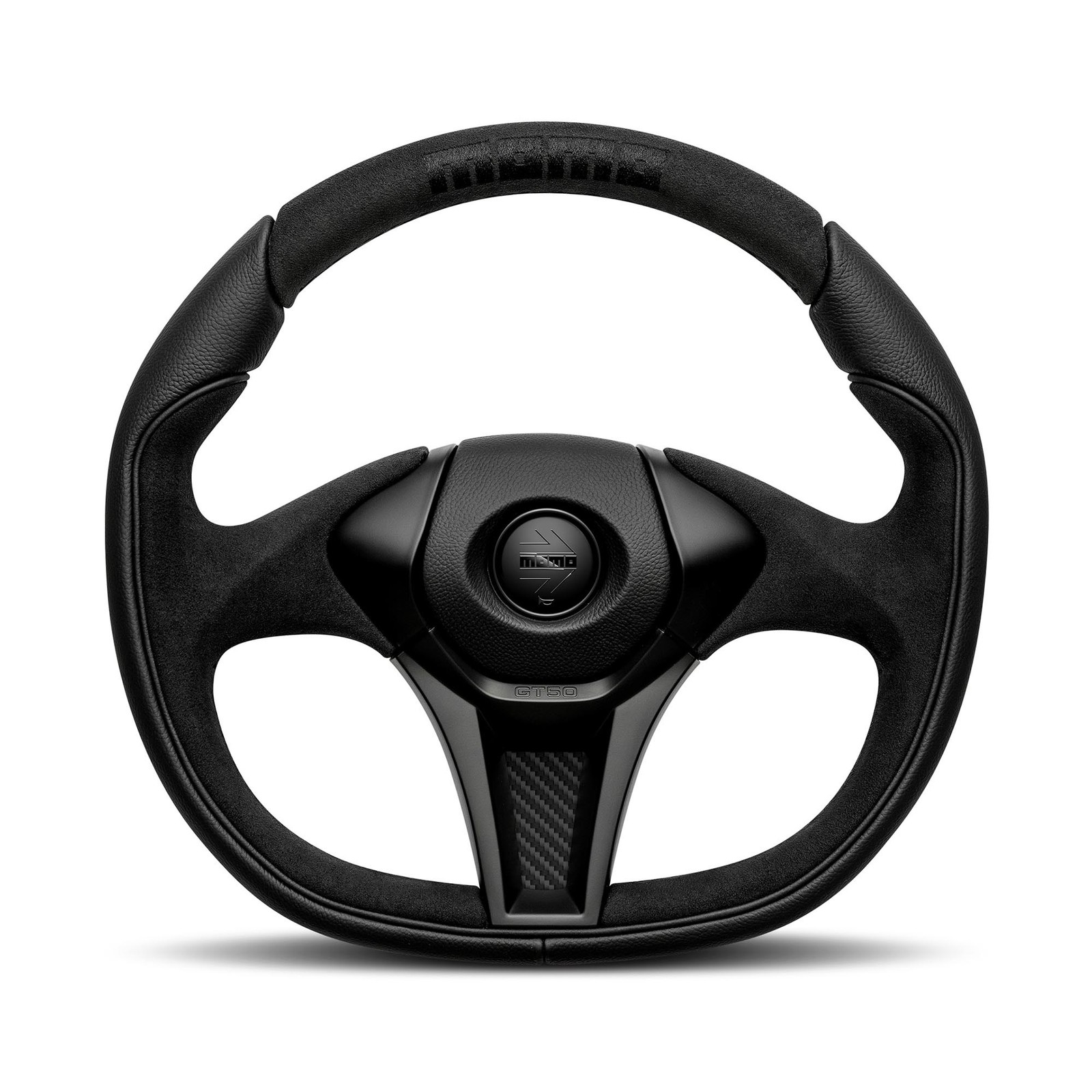
The GT50 2.0 Black Edition keeps the same 350mm diameter, 37mm dish and 34 × 29mm grip as the yellow-detail version. Its black centre pad, Black Edition button and darker detailing change the appearance. This is a finish choice within the same outline. Use the same clearance and reach measurements when comparing the two versions.
The Cromo has a gently shortened lower rim, chrome spokes and a leather grip with perforated inserts. OMP’s drawing gives 350mm width and 330mm height. Its flat dish distinguishes it from the shallow-dished MOMO street wheels. The boss kit and any spacer therefore need to be included when calculating the final distance to your hands.
These wheels use more of the available outline to make space around a low driving position or display. Some retain a closed top; others leave a large opening above the hub. Their mounting arrangements include undrilled centres alongside specific three-hole and six-hole patterns.
MOMO’s formula range lets you compare width and height independently. OMP offers the compact Indy pair and display-oriented 310 ALU GT. Sparco’s P310 pair shares a 310mm width, while the two listed F-10 parts use the same 270 × 194mm envelope with different structures.
Confirm the mounting face before ordering a formula or open-top wheel. An undrilled centre needs a suitable fitting process; a three-hole pattern needs the matching hub. Send us the existing quick-release part number and a straight-on photo of its face.
The Model 12 is a compact closed-top formula wheel with a flat lower rim. The 250mm version is 200mm high; the 260mm version is 210mm high. Both use a 35 × 24mm grip section. Its undrilled centre needs a fitting plan for the car’s hub or quick release before you settle on the size.
The Model 12C takes the 250mm formula format and opens the top. MOMO gives 165mm overall height, substantially shorter than the closed Model 12. It can leave a clearer sightline to a display behind the wheel. Hand positioning becomes a central part of the choice, particularly in a car needing considerable steering lock.
The Model 27 offers two widths with a closed top and flat bottom. The 270mm wheel is 235mm high; the 290mm version is 244mm high. Their grip sections also differ. Compare both the overall size and the section your gloved hand will wrap around, then confirm how the undrilled centre will meet the hub.
The Model 27C is the open-top member of the 27 family. It remains 270mm wide and drops to 195mm overall height, with a 36 × 26mm grip. The lower rim stays flat. It gives more space above the centre for an instrument view, while the undrilled centre allows the mounting to be matched to the car.
The Model 29 has a closed perimeter with flattened upper and lower sections. MOMO draws it at 270 × 215mm, with a 34 × 26mm grip. Compare it with the open-top 27C: one preserves a continuous upper rim and the other removes that arc. The answer depends on display position and the driver’s hand movements.
The Mod.101 is the widest MOMO formula option here at 290mm, yet its open-top outline is only 180mm high. Two button housings sit near the upper grips. It has a different envelope from the closed Model 27 at the same nominal width. Include controls, cabling and the display sightline when you sketch the installation.
The Formula Quadro has a closed top and flat lower section in a 250mm-wide outline. OMP’s current product information and drawing give 230mm overall height, with a 35 × 25mm oval grip. It is taller than the Indy at the same width. That matters around a scuttle, dashboard or the space above your thighs.
The Indy is the closed-top option in OMP’s compact Indy pair. Its 250 × 200mm dimensions keep the complete wheel smaller than the Formula Quadro outline. The 35 × 25mm suede grip retains an oval section despite the compact size. Check the drilling and hub arrangement before ordering for an existing single-seater installation.
The Indy Open keeps the 250mm width and removes the upper rim, bringing overall height down to 170mm. It is the comparison with the closed Indy when the display sits behind the top of the wheel. Both share the same nominal grip section. Plan controls around the open outline and confirm how the hub will be attached.
The 310 ALU GT is 315mm wide in OMP’s specification despite the model name. Its aluminium centre is designed around electronic displays, with MoTeC C125 and AiM MXL named by OMP. The 36 × 30mm grip is substantial beside smaller formula wheels. A display, control plate and wiring bring their own space requirements, so work through those together.
Sparco’s P310 is a closed-top GT-style wheel with flattened upper and lower sections. The maker’s drawing gives 310 × 260mm and a 35 × 28mm grip. Its six-hole 70mm mounting makes the hub discussion different from an undrilled formula wheel. Two red controls are visible on the listed version; confirm the wiring your car needs.
The P310 Open keeps the P310’s 310mm width and 35 × 28mm grip while opening the top. Overall height reduces to 200mm, a 60mm difference in the full vertical envelope. Sparco specifies six-hole 70mm mounting. Compare both outlines against the actual display position before deciding which rim works better for the cockpit.
The F-10A is Sparco’s aluminium formula wheel, 270mm wide and 194mm high. Its flattened bottom and open top surround a solid centre. The listed 015P270SSN uses three-hole 50.8mm mounting according to Sparco’s drawing. Match that exact pattern to the hub; the separate six-hole F-10 variants should not be assumed from the family name.
The F-10C is the carbon-structure partner to the aluminium F-10A. Both listed parts share the 270 × 194mm outline, 35mm grip dimension and three-hole 50.8mm mounting. Construction is the reason to compare them. Use the exact 015PC270SSN part code when checking mounting, because Sparco offers other configurations within the F-10 family.
These MOMO products appear in our steering-wheel catalogue, so they have their own group here. They are designed for the Logitech G RS Wheel Hub, sold separately. The maker publishes width and grip section; a dish figure is not supplied in the current catalogue and remains unstated below.
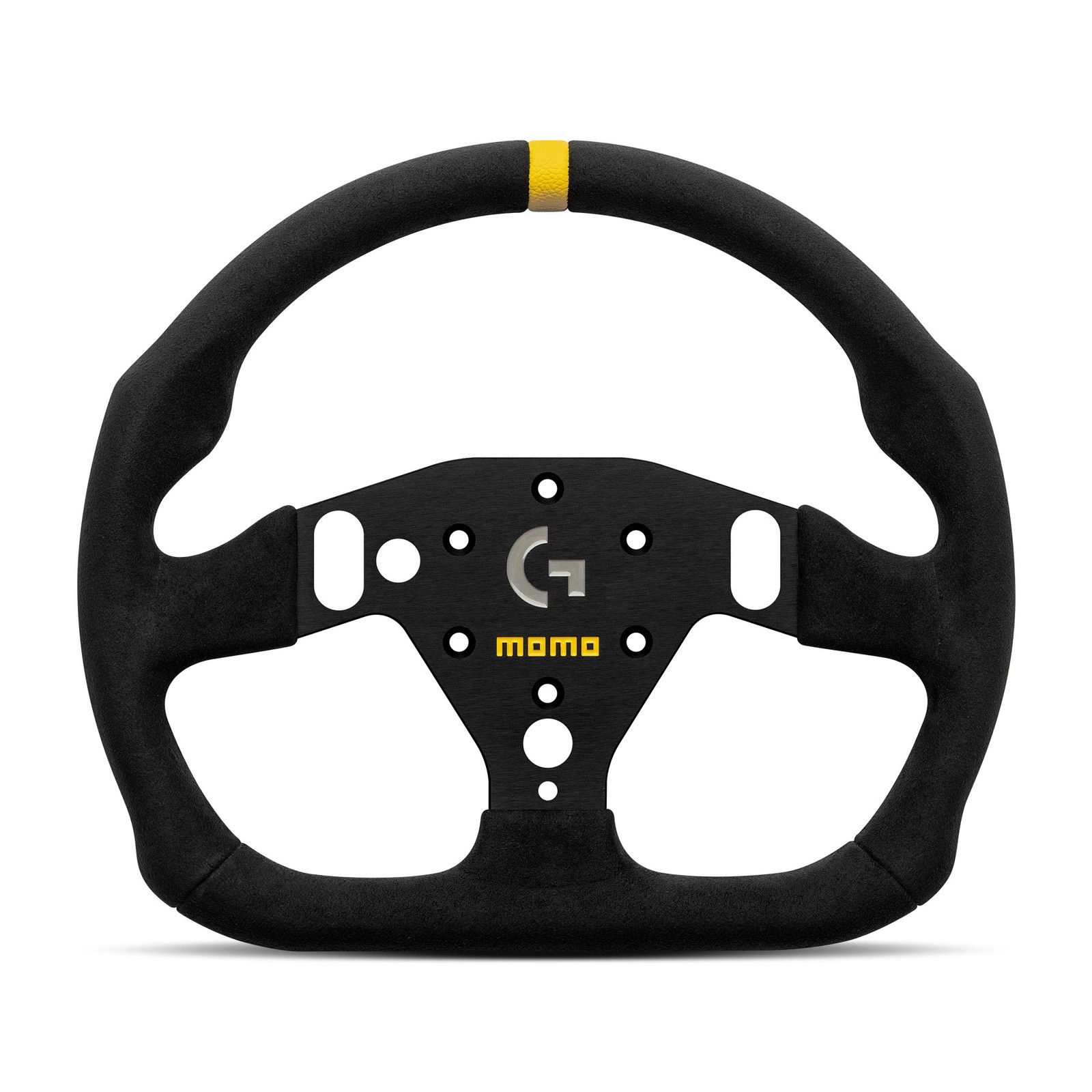
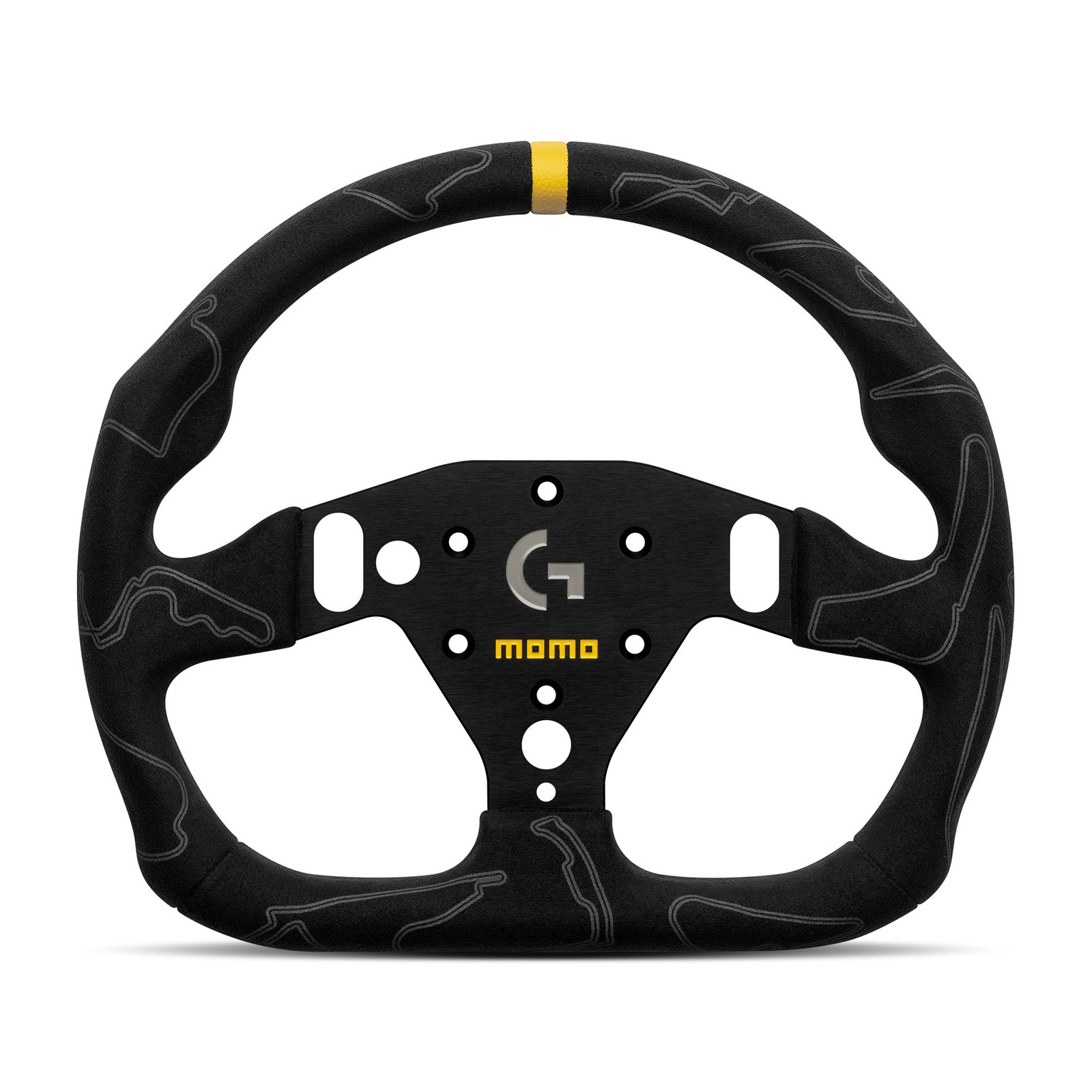
The Sim GT-Pro 320 has a closed top, pronounced flat bottom and yellow upper marker. MOMO lists a 320mm width and 35 × 25mm grip. It is made for the Logitech G RS Wheel Hub, sold separately. Treat it as a simulator component when choosing here; the hub ecosystem is part of the setup.
The Tracks version uses the same 320mm flat-bottom GT-Pro outline and 35 × 25mm grip. Circuit outlines printed around the covering distinguish it from the plain GT-Pro. Both belong to the Logitech G RS Wheel Hub system. Choose the surface treatment you prefer, then check the remaining simulator hardware against that system.
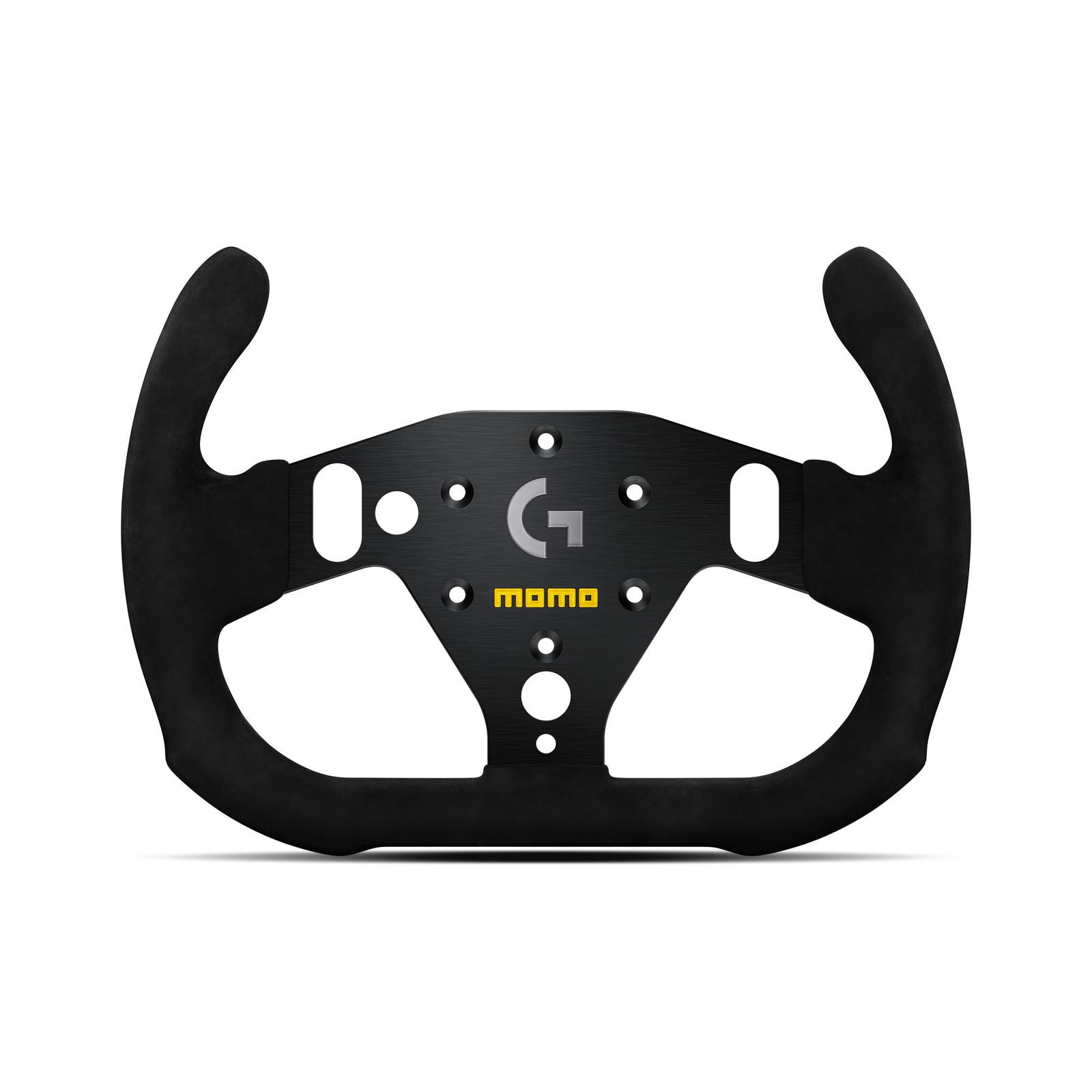
The Sim GT-Racer 290 is the open-top formula-style option in this Logitech G collaboration. Its 290mm width and 32 × 26mm grip sit in a compact outline with a flat lower rim. Our listing offers black and red covering options. The Logitech G RS Wheel Hub is separate, so include it in the simulator setup.
Plan the wheel, boss and driving position together
Start with the position you already know. Record the current wheel’s diameter and dish, then measure from the mounting face to the grip. Include any spacer or quick release. This gives you a reference for the replacement’s reach.
Set the seat and column for driving, including the seat height you intend to use.
Measure the present lower-rim clearance at straight ahead, then check the space as the wheel turns.
Place the new wheel’s full outline around the steering axis. Check the upper edge against the display and the sides against the cockpit.
Match the drilled pattern or undrilled centre to the hub or quick release.
Confirm the boss kit against the car’s make, model and year.
Plan the horn, switches, cable routing and any display bracket with the exact wheel version.
A smaller diameter reduces hand travel for the same wheel angle. It also reduces leverage, so the effort at your hands can rise. It leaves the steering rack ratio unchanged. A flat lower section adds clearance mainly when that section is underneath the hub; turning the wheel moves the shape around.
Send us the wheel you are replacing and the reason for changing it. “The lower rim touches my legs” leads to a different shortlist from “I cannot see the display”. The measurements above help us narrow that down without guessing.
Cameron’s fitting view
Keep the boss and any quick release in the comparison. Changing a 0mm wheel to a 43mm-dish wheel while also adding a quick release can move the grip considerably. Check the whole assembly against your comfortable reach.
Keep the measurements with the car
Add your car to the website garage and save the shortlisted products to its wishlist. You can keep the wheel, boss and other components together with the parts you have already bought, which makes a later fitting enquiry much easier to follow.
Flat-bottom steering-wheel questions
Does a flat-bottom steering wheel have a flat dish?
Those are separate dimensions. Flat bottom describes the lower rim shape; dish describes how far the grip is offset from the mounting face. The MOMO Model 88 has a flat lower rim and a 43mm dish.
How much extra knee room will a D-shaped wheel give me?
The lower cut can add room with the wheel straight ahead. The amount depends on the steering axis, rim shape and seat position. Overall height alone cannot give an exact knee-clearance gain; measure the lower edge relative to the mounting centre.
Is a smaller steering wheel quicker?
The steering rack ratio stays the same. A smaller rim reduces hand travel for a given wheel angle and gives less leverage, so effort can increase. Choose around the car’s steering system and the driver’s movements.
Which wheel has the smallest published overall height?
Among the physical-car wheels with a complete manufacturer height shown here, the MOMO Model 12C is 250mm wide and 165mm high. It is a formula-style open-top wheel with an undrilled centre.
Will every wheel fit a MOMO-pattern boss kit?
Check the exact part. Some use six holes on a 70mm PCD, the listed Sparco F-10A and F-10C use three holes on a 50.8mm PCD, and several formula wheels have undrilled centres. The boss must also match the car.
Are the listed wheels in the showroom?
This is our online range, checked on 6 November 2026. Display stock changes. Email us the models you want to compare before travelling and we will confirm what can be seen.
Can I fit the Logitech G collaboration wheels in a car?
MOMO lists these as sim-racing products for the Logitech G RS Wheel Hub. Keep them within that simulator setup when choosing from this guide.
What information should I send for fitting advice?
Send the car’s make, model and year; current wheel and boss or quick-release part numbers; the wheel you want; and photos of the mounting face and driving position. Add any display or controls you need to retain.
Dimensions and manufacturer references
We checked the complete published steering-wheel category and inspected the product images for this guide. The tables cover the listed flat-bottom, shortened-lower-rim and open-top variants. Colour and diameter choices remain on their linked product pages. The round-rim Targa, R330 and SW-833 belong in a flat-dish comparison; their flat depth alone does not make them flat-bottom wheels.
Dimensions use the manufacturer references below. Where a drawing supplies an overall height, it is shown alongside the nominal width. We have left unreported heights blank, and kept simulator dish figures unstated. Purchasing options and availability are confirmed on the product page or by email.
MOMO Motorsport Collection 2025: Model 30 and 88, plus the formula range, with width, overall height, dish and grip-section drawings.
Garreth can help narrow the choices, and Cameron can help with the fitting measurements. We are a small family retail business, so a clear email with the exact wheel, mounting parts and car details lets us give you a useful answer.
You are welcome to visit the showroom. Check the display models with us first so the visit covers the wheels you want to compare. We supply the parts and fitting advice; installation is carried out by your chosen installer.
Not sure what fits, which approval you need, or what to choose next? Ask Garreth and Cameron. You’ll get a practical answer from people who handle the kit every day.