Call Garreth, Cameron & CallyAI: 0115 9893488

Free UK shipping on orders over £100.00 FREE gifts on checkout

Useful Links
Your Account

Talk to us

Garreth, Cameron & CallyAI · Mon to Fri
Call 0115 989 3488Free advice on your build
Thanks, that’s with us. We reply the same working day.
That didn’t send. Please give us a call instead.

Useful Links

Quick Access

Want to chat?

Call Garreth, Cameron, CallyAI
Today On: 0115 9893488
Click Here For Our Contact Form
Buy gift vouchers today


Social
FacebookXInstagramTikTokYouTubePinterest
Fire safety / Hand-held

Buy from the current rule, then mount it for the crew

A portable extinguisher can be mandatory, supplementary or unsuitable depending on the event. Capacity, agent, mounting and access all come from the applicable rule rather than from preference.

RequirementDiscipline-specific
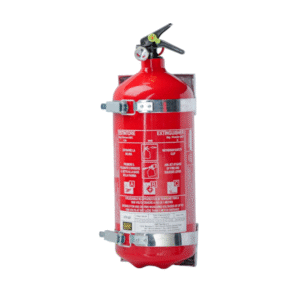
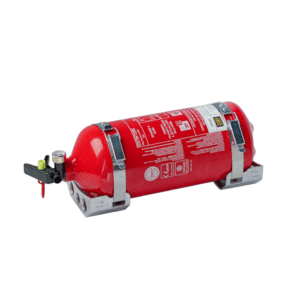
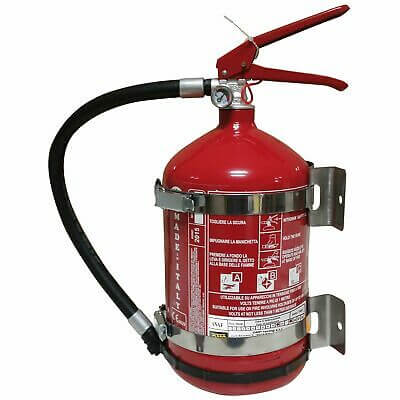
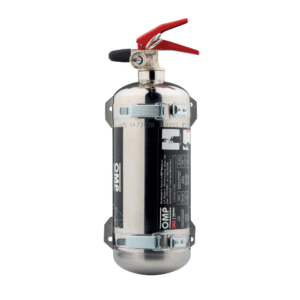
MountingTwo metal releases
Restraint25g provision
In stockEight units
The short version

A bottle loose behind a seat is a heavy projectile, so the bracket gets checked as carefully as the agent inside it. Both crew members should know how it releases before the car reaches scrutineering, not after somebody needs it.

Do not use this page as firefighting training

Your first job in a vehicle fire is to get out and alert marshals. Only consider using a hand-held extinguisher when there is a safe exit, the fire is small and you have been trained to do it.

01 / Before buying

Hand-held requirements are not universal

Read the discipline chapter, the championship regulations and the event documents, in that order. Where Motorsport UK requires a hand-held unit, Chapter 7 Appendix 6 sets out the permitted extinguishants, the capacities and the mounting provisions. An FIA 8865-2015 hand-held system is a separate specified route.

The mistake we see most is a rally specification copied straight into a speed or drag car. They are different chapters with different provisions, and a list that is exactly right for one can be both over and under specified for the other.

A hand-held unit and a plumbed-in system are also not alternatives by default. Some classes want one, some want the other, and some want both. If a plumbed-in system is what you actually need, see the mechanical and electrical guides.

02 / What we stock

Dry powder, foam or Novec gas

Eight units. The agent decides the price and decides what your car looks like afterwards.

UnitAgentSizeApproval
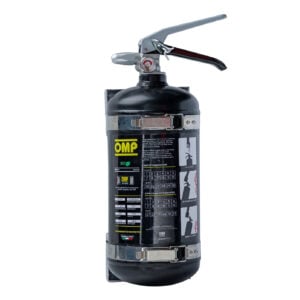
OMP 2kg powderCHECK THIS ONEDry powder2kgEN3 and MSA. Not FIA
OMP 3kg powderDry powder3kgFIA and Motorsport UK
OMP 4kg powderDry powder4kgFIA and Motorsport UK
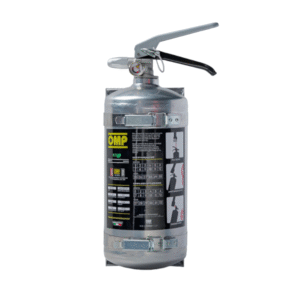
OMP Ecolife PlusFoam2.4 litreFIA and Motorsport UK
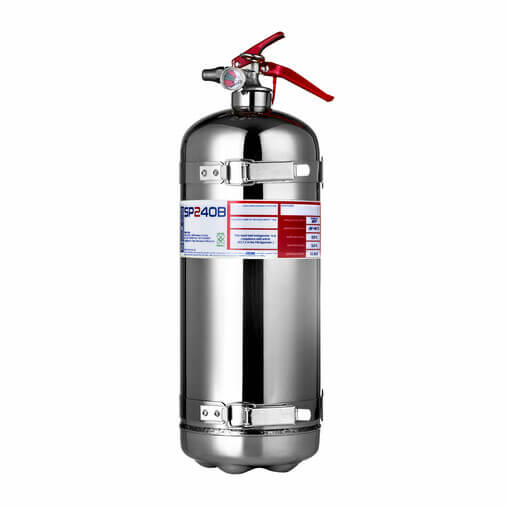
Sparco AFFFFoam2.4 litreFIA and Motorsport UK
OMP Ecolife Plus steelFoam2.4 litreFIA and Motorsport UK
Sparco NovecNovec gas2kgFIA and Motorsport UK
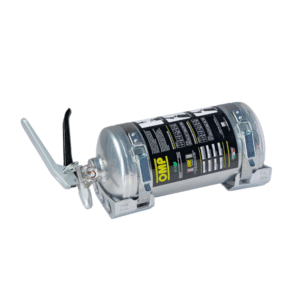
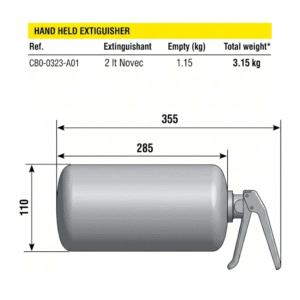
OMP NovecNovec gas2kgFIA and Motorsport UK

Dry powder is cheap, works on most things and is the one to have if budget is the constraint. It is also appalling to clean up. It is a fine abrasive that gets into everything, it is corrosive to alloy over time, and a car that has had a powder extinguisher emptied into the engine bay usually needs stripping properly afterwards.

Foam sits in the middle and is what most people end up with. It knocks fuel fires down very well, which is the fire you are most likely to be dealing with, and the mess is at least washable.

Novec is a clean agent that leaves nothing behind. It costs roughly three times what powder does, and it is the one to buy if the thing you would be pointing it at has a loom, an ECU or a dashboard behind it. On a car with serious electronics, the price difference is less than the cost of cleaning up after a powder discharge.

One thing to watch in that table, because it is the cheapest unit on the page and the one people reach for first. The OMP 2kg dry powder is EN3 homologated and Motorsport UK approved, and it is not FIA approved. For a club event that accepts the Motorsport UK route it is fine. If your regulations name FIA, the 3kg is the next one up and costs about eleven pounds more.

Everything else on this page is FIA and Motorsport UK approved. Whatever any listing says, ours included, the label on the physical bottle is what a scrutineer reads and what counts.


  • ,

    £69.00 Excl. VAT Add to basket
  • ,

    £80.00 Excl. VAT Add to basket
  • ,

    £88.00 Excl. VAT Add to basket
  • ,

    £104.00 Excl. VAT Add to basket
  • ,

    £145.00 Excl. VAT Add to basket
  • ,

    £188.00 Excl. VAT Add to basket
  • ,

    £277.00 Excl. VAT Add to basket
  • ,

    £298.00 Excl. VAT Add to basket
03 / Identity

Agent and capacity have to be legible

Check the physical label for the agent, the charge, the homologation where one applies, and the service details. A product title saying foam, gas or clean agent proves nothing on its own, and titles vary between suppliers for identical bottles.

Then keep the label visible once it is mounted. This sounds trivial and it is one of the more common reasons a car gets sent away from scrutineering: the bracket has been fitted with the label facing a bulkhead and nobody can read the service date without taking it off.

04 / In the car

Secure under load, quick to release

The 2026 NCR is specific about this and it is where most installations fall down.

1

Mountings rated to 25g

The mounting has to withstand 25g. That is the number that turns a 4kg bottle into a 100kg problem in an impact, and it is why a hardware-shop bracket is not acceptable.

2

Two quick-release metal fastenings

At least two, with metal straps. Plastic quick-release brackets, the sort supplied with road extinguishers, do not meet the provision where Article 3 applies.

3

Anti-torpedo tabs

Required, and they are the detail most often missing. They stop the bottle sliding out of the straps lengthways under load.

4

Inside the main structure

Bottles cannot be mounted outside the main structure. Check too that the bracket cannot foul a seat, a harness, a sharp edge or the crew getting out.

Weigh the mounting decision as well as the bottle

A 4kg powder unit is the most agent for the least money, and it is also the heaviest thing you have to restrain to 25g and the most awkward to get out of a bracket one-handed. For a lot of cars a 2.4 litre foam unit is the better whole-system answer.

05 / Before each event

Access and paperwork both fail scrutineering

The driver and the co-driver must be able to reach the unit where the rule requires it, and reaching it means belted in and dressed, not leaning in through the door. Practise the release on the empty bracket, or follow the maker familiarisation method, so that both crew members have actually done it once.

Before each event, check the pressure indication where one is fitted, the pin, the hose, corrosion around the base and the bracket fixings, and whether the label is still legible. Put that on the same preparation sheet as tyre pressures rather than trusting memory.

Service through the manufacturer-supported route so the record stands up, and never discharge a competition bottle for practice. If you want to learn how one handles, do it on formal training equipment.

06 / Questions

Hand-held extinguisher questions

Does a hand-held replace a plumbed-in system?

Only where the rules for that discipline and class permit that arrangement. In some events both are required, so read the chapter rather than assuming.

Which agent should I buy?

Foam for most cars. Dry powder if budget is the constraint and you accept the cleanup. Novec if there is a loom, an ECU or a dashboard behind whatever you would be pointing it at.

Is dry powder really that bad afterwards?

It is a fine abrasive that gets everywhere and is corrosive to alloy over time. It puts fires out perfectly well. The cost lands after the event rather than at the till.

Can I use a plastic quick-release bracket?

No. The current Motorsport UK provision specifies quick-release metal fastenings and metal straps where Article 3 applies, plus anti-torpedo tabs.

Where should I mount it?

Inside the main structure, protected, restrained to the 25g provision, and accessible to the crew as the rule requires. Check it does not foul a seat, harness or your exit.

Is a bigger bottle always better?

Not once you account for mounting it to 25g and getting it out one-handed while belted in. A 2.4 litre foam unit is often the better whole-car answer than a 4kg powder one.

Should I discharge one to learn how it works?

No. Use formal training equipment or the manufacturer safe familiarisation advice. A discharged competition bottle is an expensive lesson and leaves you without an extinguisher.

Send us the discipline and the car layout

We will check the bottle and the bracket together

Include the class, the event, the crew arrangement and a photograph of where you plan to mount it. The bracket is the half of this that gets people turned away, and it is much easier to sort before the holes are drilled.

Browse hand-held unitsContact usBook the showroom

What our customers say

Free UK Shipping

On all orders above £100

In-Store Shopping

Try before you buy

Easy Delivery Tracking

Aftership Tracking Updates

How can i help?

Before you leave. Is there anything I can assist with? With 17 years of industry knowledge and hands-on experience, I’m here to help. Let’s get you race ready!